Karbala and Najaf: two of Iraq’s – if not Islam’s – holiest cities. As you might imagine, visiting these Shia shrine cities is a bit of serious business. There is major pilgrim traffic in both, and a completely different atmosphere to Baghdad or Mosul. Both draw millions of devout visitors every year from all over the Muslim world, to pay their respects at the tombs of the 1st and 3rd Imams Ali and Hussain (and Hussain’s half-brother Abbas), according to Shia tradition.
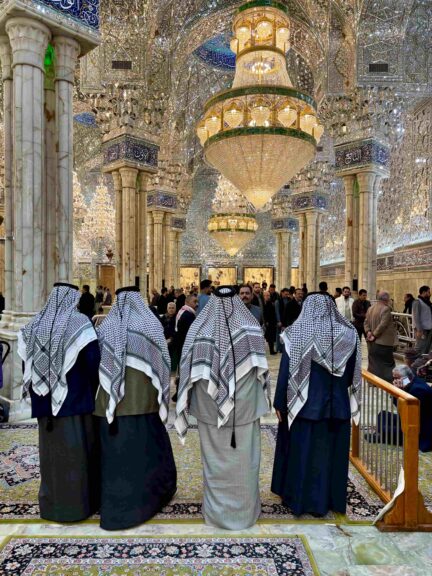
Religious pilgrim or not, if you’re traveling in Iraq you will want to go to these cities for sure.
Due to the possibility of sectarian violence there is tight security and police presence on the way to and in both Karbala and Najaf. You’ll get used to it quickly and won’t notice it too much. Just follow the rules about clothing and be respectful at the checks.
A lot of the info in this post – what to wear, and rules for visiting the mosques and the shrines – applies likewise to the mosques Al-Askari in Samarra and Kadhimiya in Baghdad.
Karbala or Najaf?
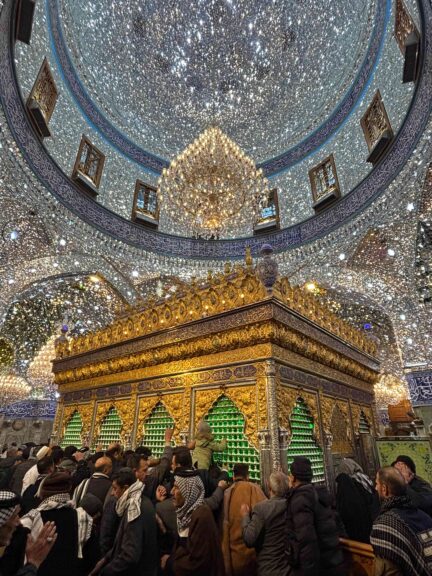
Ideally I’d try to stay a couple of nights each in both Karbala and Najaf (that’s what we did). If you’re short on time you could base yourself in one of them and daytrip for part of a day to the other. We found better accommodation options in Karbala, but in Najaf the shrine complex is even more impressive (and that is saying a lot).
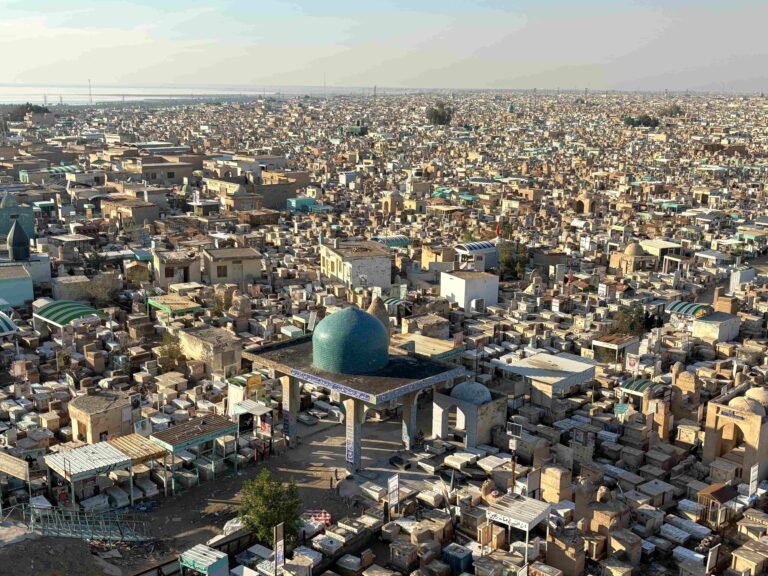
Plus you have Wadi Al Salam, the world’s biggest cemetery in Najaf, and that alone is worth having a look.
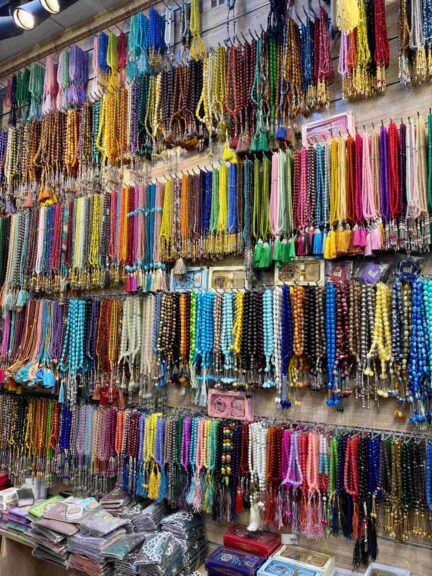
There are also great labyrinth-like souks to wander through in Najaf especially.
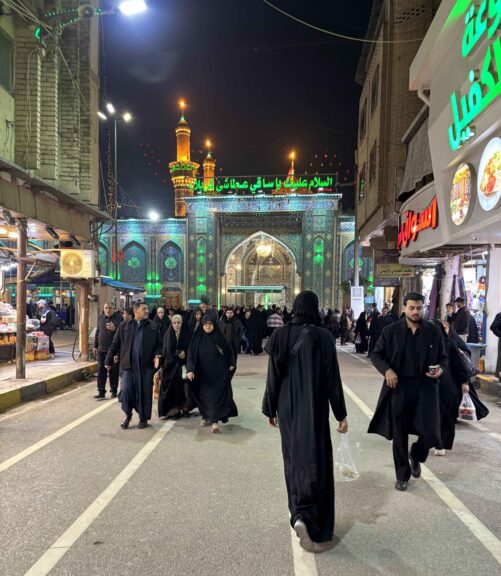
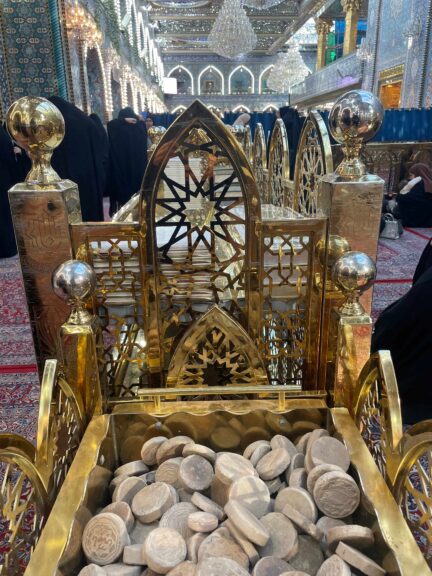
Karbala – the Shrines of Imam Hussain and Abbas
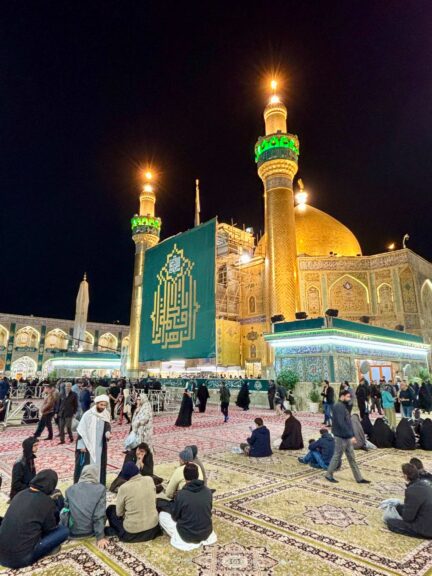
In the heart of the old city are the massive Holy Shrines of Imam Hussain (a son of Imam Ali) and of his half-brother Abbas. These two shrines are the focus of Karbala and of everyone in it.
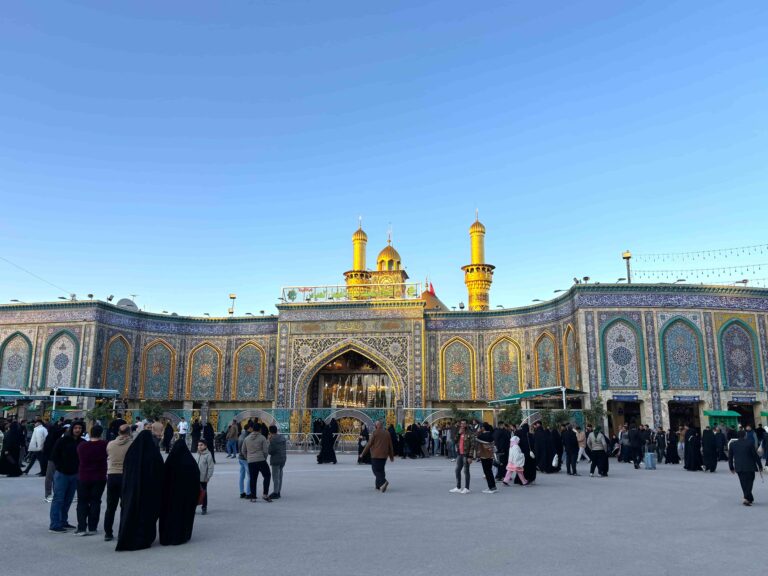
Hussain and Abbas were martyred together in the Battle of Karbala in 680 AD, fought over succession to the caliphate. Hussain’s mosque is said to be built on the very site of the battle, itself one of the most important events in Shia beliefs.
Karbala also hosts the world’s largest annual public gathering. Not every day, of course, although it can honestly feel like that in the old city especially at night. The Arbaʿeen pilgrimage marks the end of a forty day period of mourning after the martyrdom of Imam Hussain, during which the battle and Hussain’s death are recreated, to a lot of frenzied grief and apparently even some self-flagellation. Millions of people (mostly Shia) travel to Karbala – many walk hundreds of kilometers to join in. If you’re going to be in Karbala at the same time you definitely want to be aware of that in advance since the city will be bursting at the seams.
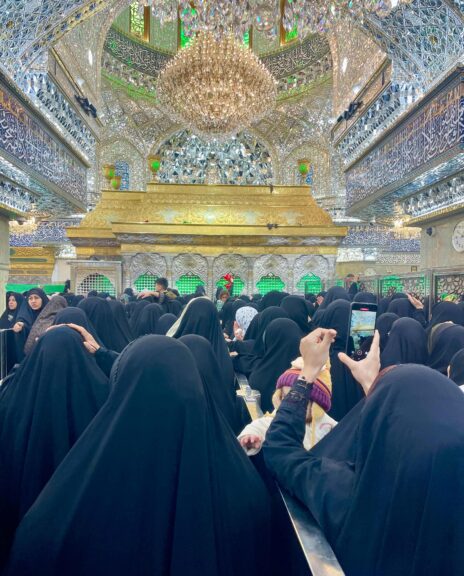
Najaf – the Shrine of Imam Ali
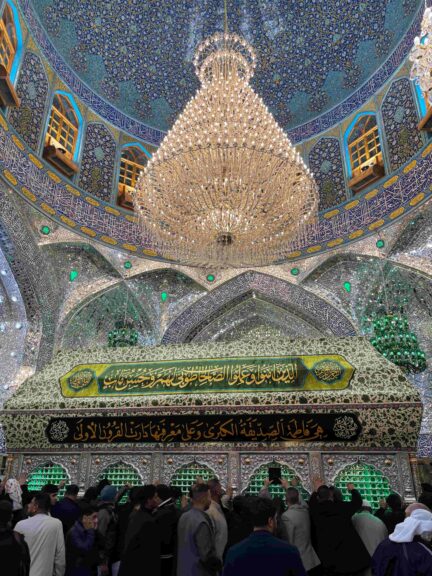
The main attraction here: the Holy Shrine of Imam Ali, 4th Caliph and son-in-law of the Prophet Mohammed. The shrine complex in Najaf is even more impressive than in Karbala, if that’s at all possible, and also thronged by pilgrims day and night.
Ali was stabbed in 661 AD, while praying in the main mosque in Kufa, erstwhile capital of the Abbasid empire and bastion of his own support. His murder led to the Sunni-Shia schism.
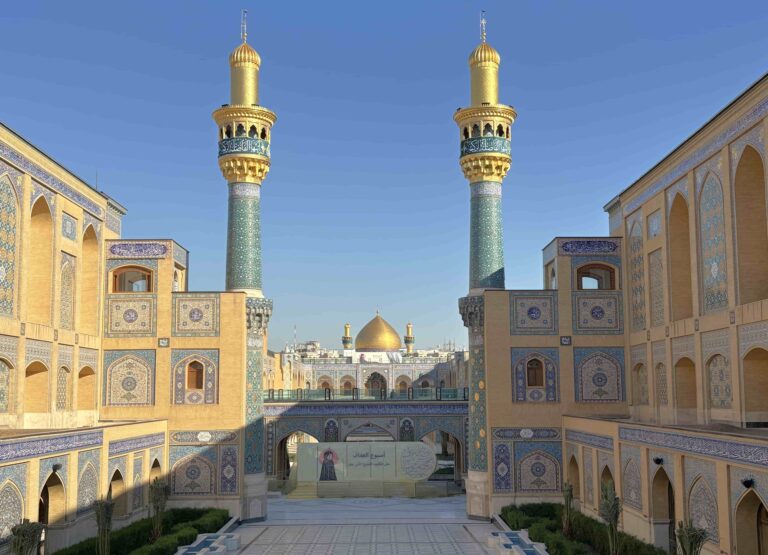
Before he died, he ordered that his body should be placed on a camel, and the camel let to wander. Where it stopped, there he should be buried. And so his burial place was kept secret. Until they built this massive shrine and the city of Najaf on the spot, at any rate. Unless…you among those who believe he’s actually buried in Mazar-i-Sharif.
What to wear in Karbala and Najaf
Najaf, and Karbala are holy cities with a certain type of atmosphere. For women, an abaya and hijab or a chador is mandatory in the Haram part of these cities – the areas of the old city surrounding the shrines – and certainly in and around the shrines themselves. That means wearing it most of the time in Najaf and Karbala since you will likely spend the bulk of your time in those areas. As soon as you arrive at the haram area you need to have an abaya and hijab or a chador on. You can buy these on the way in from the new town and all over the haram. I bought mine in Baghdad and had it on when we arrived in each city, and that felt more comfortable.
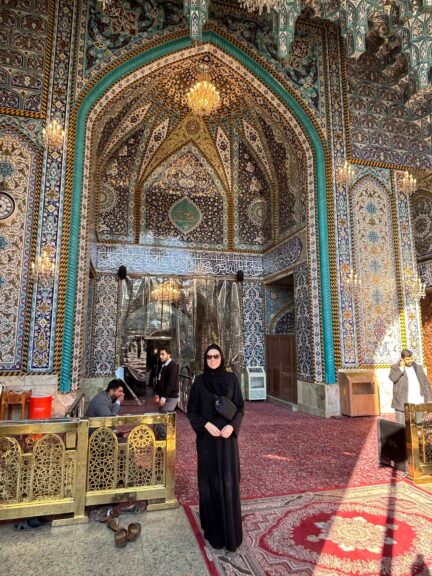
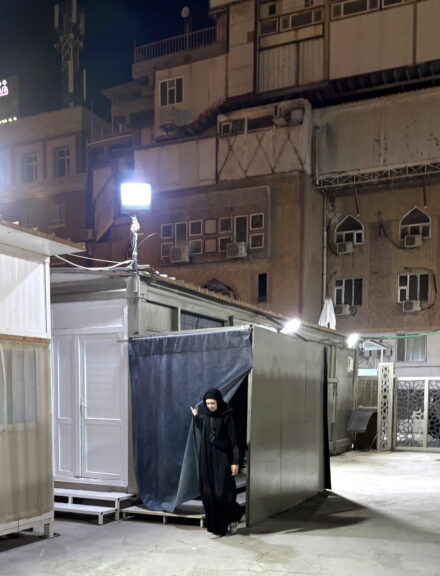
It’s easy to see where the haram area begins. There are walls and security checks, which double as modesty checks for women and you’ll get no further without the right clothes. Men and women enter separately and the women’s checks are inside big tents signed with pictures of women wearing abayas. Although you don’t have to wear it outside these holy areas you might as well because you’ll really stick out otherwise. At very least, I’d wear a loose headscarf.
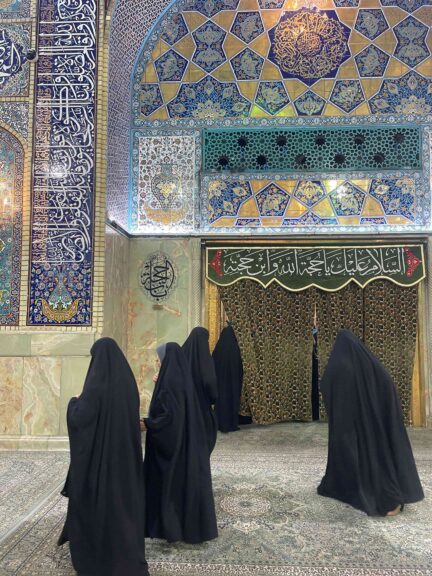
Inside the holy areas and the shrines themselves, not even a strand of visible hair is allowed. I was flagged a few times for this: workers with huge green feather dusters tapped me and pointed it out. So I bought an undercap – basically a tube top for your head – to solve this problem. Just go to any market stall selling women’s clothes and accessories and ask for a cap. You can also get a hijab stuffer while you’re at it.
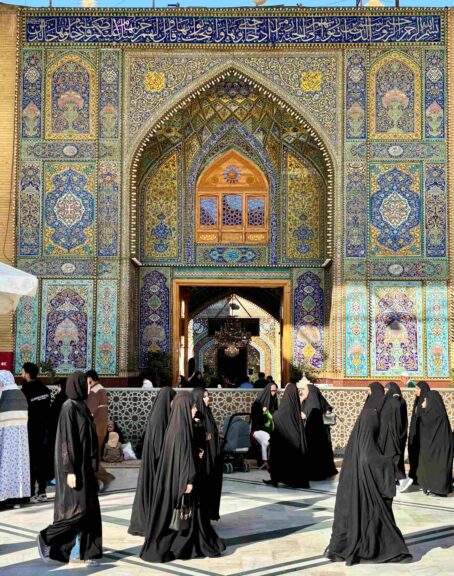
Visiting the shrines in Karbala and Najaf
You’ll easily spend a couple of days just visiting the mosques, they are magnificent and fascinating. We went several times any given day to experience the atmosphere at night, in the afternoon, and so on.
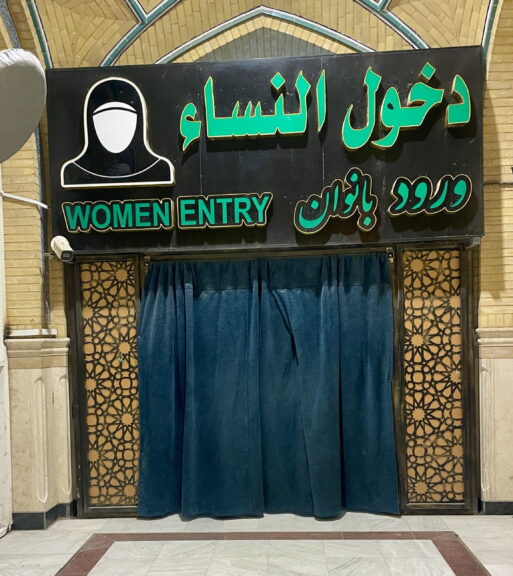
When you visit, here are some things to keep in mind:
- there are separate sides in the mosques for men and women so if you’re with someone, expect to split up
- these places are massive. take note of the name or number of the gate you enter at, so as to exit again where your shoes are (and potentially your partner)
- women can wear makeup. I saw plenty of women inside with a faceful of it and I had some on myself.
- cameras are not allowed but phones are fine. In certain spots it’s clearly signed if you can’t take photos.
- there is free storage for your shoes and also for cameras or any other bags you might have. Purses are fine, you can take them with you.
- men and women enter separately, with separate security checks. This applies throughout town and you will go through these checks constantly.
Where we stayed in Karbala
We stayed at the Mayali hotel. Like many others, this hotel is inside the old city area so we had to go through all the security checks to reach it. It cost 57k dinar for two people, per night, no breakfast included. It was perfectly clean and comfortable.
Where we stayed in Najaf
We stayed in the new city but still had to go through security to get to the hotel area. There are quite a few all in the same spot, and all fairly expensive. The first night we stayed at Nobles Palace Hotel for 70 USD and it was really nice. The next day we nevertheless moved across the street to Anis Al-Nufous Hotel for 20k dinar per person – very simple and basic but clean and fine. And noisy due to a huge family in the next room.
Daytrip from Karbala to Babylon
We couldn’t spend all our time ogling the ceilings in the shrines, so we daytripped to Babylon. Reaching Babylon by public transport is simple and you can do it yourself. Note that you can also make this daytrip from Najaf.
See this post for details about making a daytrip to Babylon from Karbala on public transport.
Getting to Karbala to Najaf
We went from Baghdad to Karbala and on to Najaf from there.
Baghdad > Karbala
From Alawi Garage in Baghdad somebody offered us a private taxi for 30k dinar to Karbala, but we took a coaster for 3.5k dinar each. Including traffic and getting off at a checkpoint to hang out with the police…the trip took about two and a half hours. We arrived late in the evening but the city was jam-packed with pedestrians and finding a room was not an issue.
Karbala > Najaf
From Karbala we walked to the garage and took a coaster to Najaf for 2.5k per person. That took just a little over an hour, with a short delay at a checkpoint. In Najaf the coaster dropped us in a garage a short distance from the haram area and there are busses that run the rest of the way into town for 1k.
Najaf > Nasiriyah
Eventually, we went from Najaf to Nasiriyah. In Najaf we got up at six and went out in the street to catch a cab for 5000 dinars to the Southern Garage. From there, it’s easy to catch a minibus to Nasiriyah for 10k each.
You can read about our entire itinerary in Iraq in more detail in this post: Iraq travel guide and itinerary.
Read More
If you’re planning a trip to Iraq, have a look at our Iraq travel guide and itinerary. And, find out more about our own independent travels in Iraq, here.
Check out the Destinations page for travel guides and stories about our off-beat adventures all over the Middle East and beyond.