After travelling in Iraq for a couple of weeks we crossed the border into Kuwait and immediately felt ready for a dramatic change of scenery. And so with a hop, skip and a flight along the peninsula – we set off roadtripping in Oman.
Let me just say one thing: wow.
And then let me say a few more things…
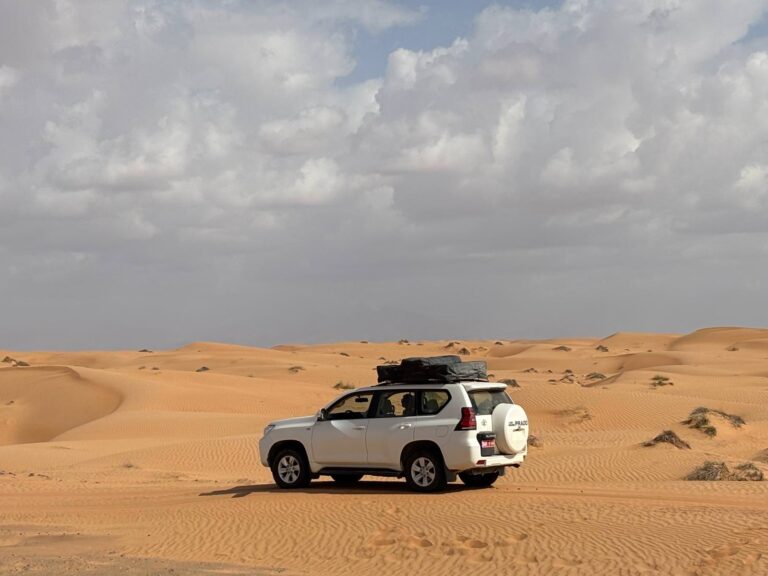
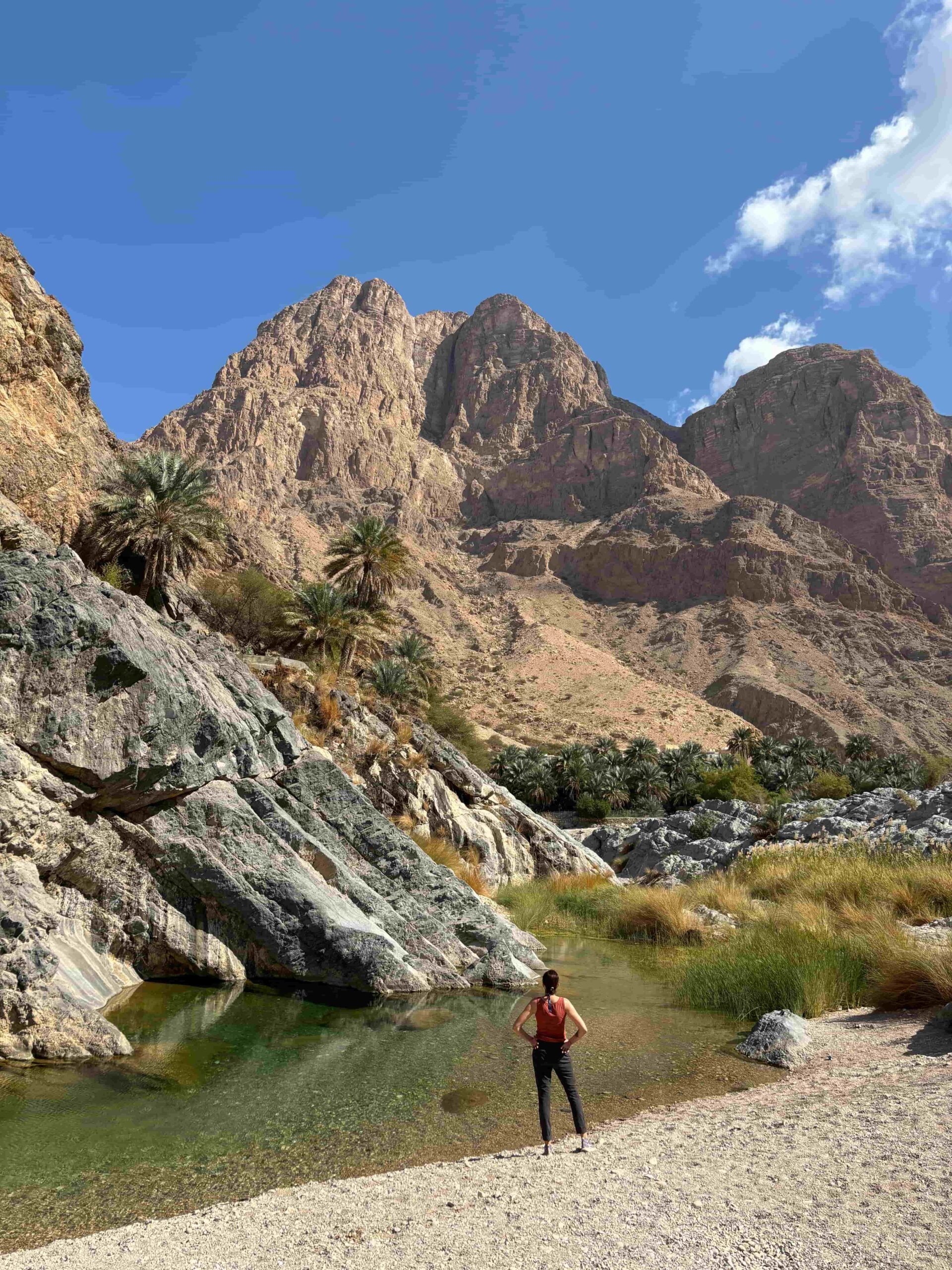
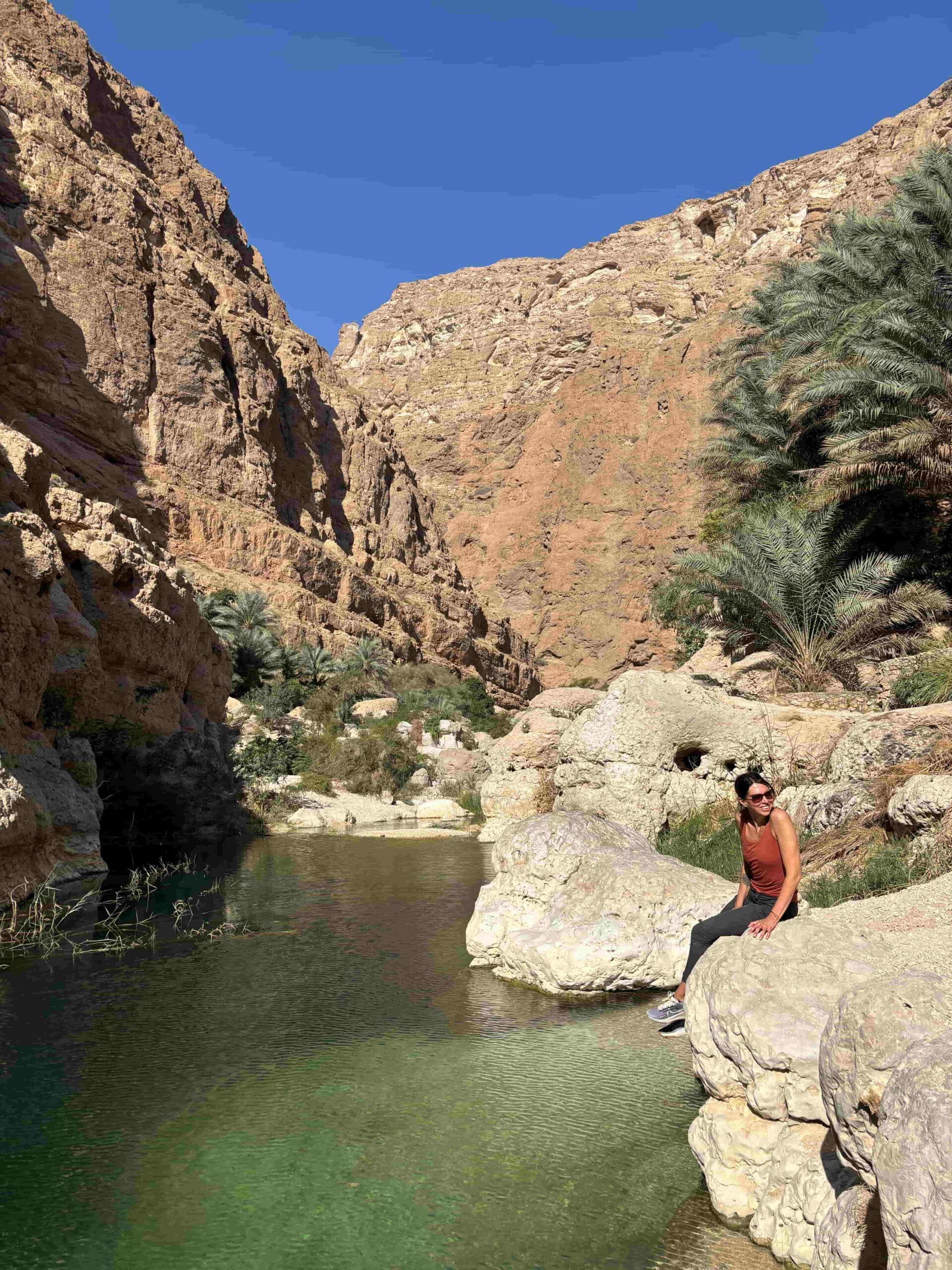
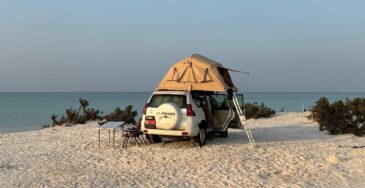
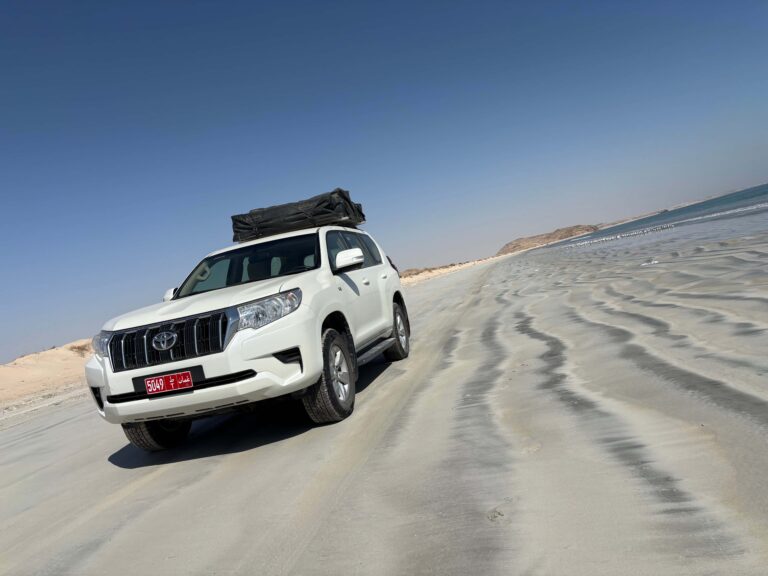
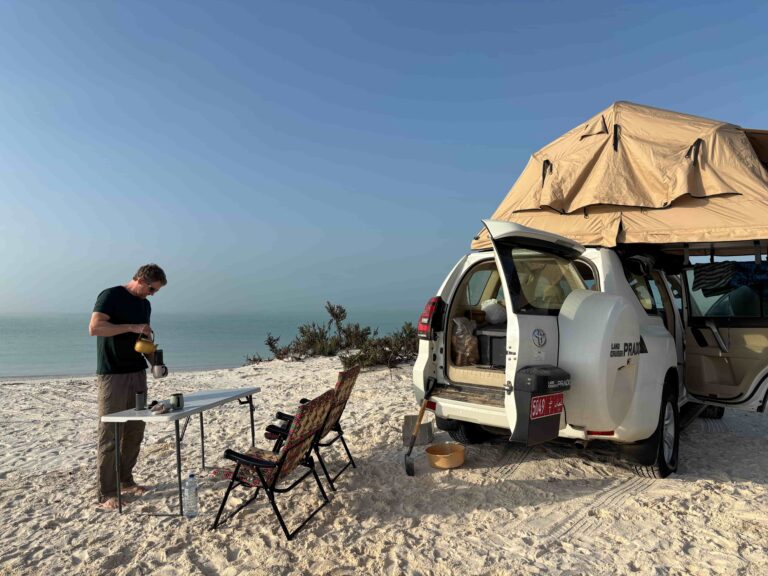
Imagine waking up in the desert, the sand still cool from the chill of night, packed hard underfoot and making a morning coffee. Then driving an hour or two and setting up camp again – this time on a remote, white sandy beach. Falling asleep in a roof tent listening to the crashing waves as high tide rolls in. Spending a day lazing around a solitary beach camp, building a fire, cooking some dinner. Moving camp again, maybe this time to a windswept cliff overlooking another beach. Driving right off the road and wild camping almost anywhere. Going for a long hike and some serious scrambling through a rocky wadi gouged out of a canyon, tip-toeing over the stones into emerald green pools. Driving on a precipitous road into the mountains for some cold air, dizzying views, and a refreshing night’s sleep surrounded only by total silence. Throw in some beautiful mosques and forts, souks where clouds of frankincense hang in the air, a bit of snorkeling and a lot of sea turtles, and there you have two weeks roadtripping in Oman.
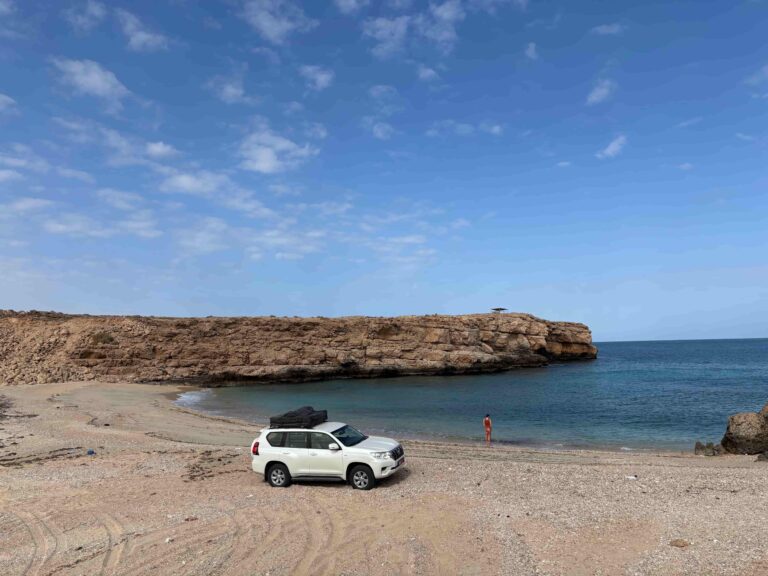
If you like road trips then this one’s got it all. Thinking about taking it on? Or at least, maybe thinking ‘what’s a wadi?’ In this post I’ve outlined our 12-day self-driving itinerary, and lots of info to help you plan your own road trip in Oman. And where to find all the best wadis, of course.
Transportation and accommodation
Self-driving and wild camping
Before you go – planning your trip to Oman
How many days for a roadtrip in Oman?
Things to bring (and useful apps)
Costs
Keeping in touch
On the road in Oman – our itinerary
Back to Muscat
Transportation and accommodation
This post is about self-driving with an off-road capable vehicle and wild camping, but there are a few different ways you can travel around in Oman.
Starting from Muscat, the capital, you can plan to travel by:
- Regular car, camping or hotels. If you’re short on time or don’t want to hire a 4×4 (or live in one for days at a time), you can easily get around the northern ‘loop’ from Muscat in a few days driving a regular car. To read about the days we spent in the northern areas, see days 1-4 and 10-12 in this post. You can stay in a wide range of hotels along the way, or you can hire camp gear separately and throw it in the car. Camping or not, a shorter trip without a 4WD will limit what you can actually do and if you’re chasing that remote wild feeling – you won’t get it. As for the south of Oman, in this scenario you could drive the northern loop, return your car, fly to Salalah and hire another car for a few more days and do the same thing there.
- Car and driver, taxi, buses. Not a great alternative in Oman, but you could base yourself in Muscat and patch together some rides and daytrips from there.
- Self-driving 4×4 and camping (as in this post). It’s more expensive to hire a 4×4 fully equipped for camping, but personally I think it’s the way to go. It allows for much more flexibility in terms of destinations and the time (if you have it) to really get out there and explore. You can drive the loop in the north, as we did, and then just keep driving south all the way till Yemen, if you feel like it.
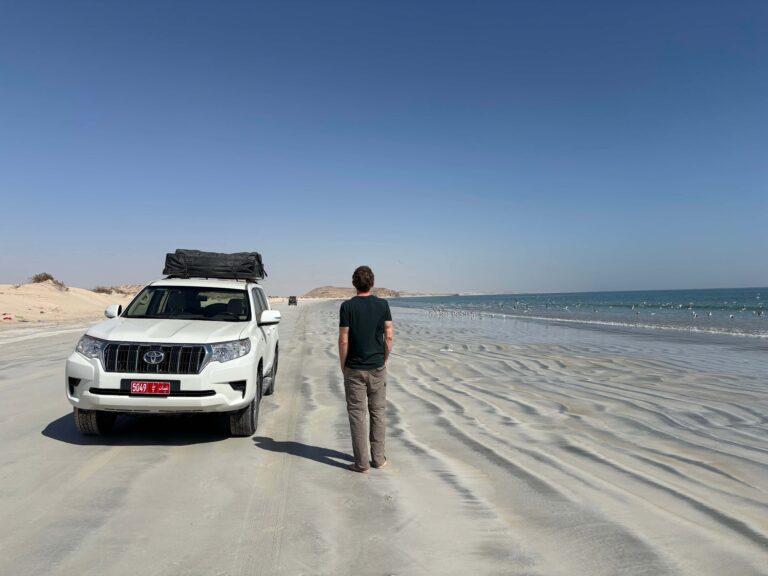
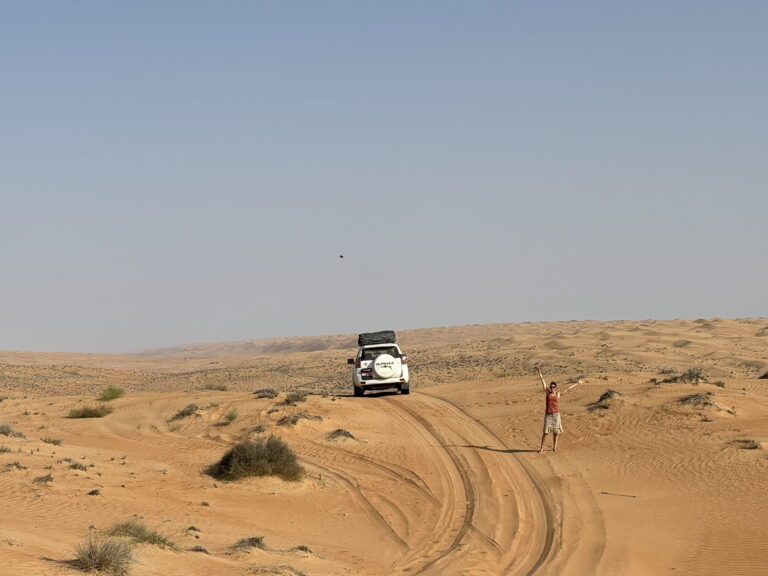
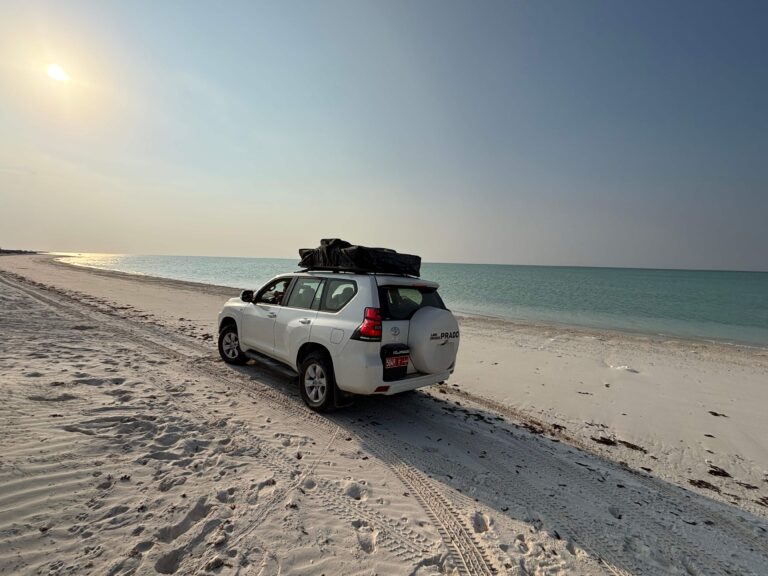
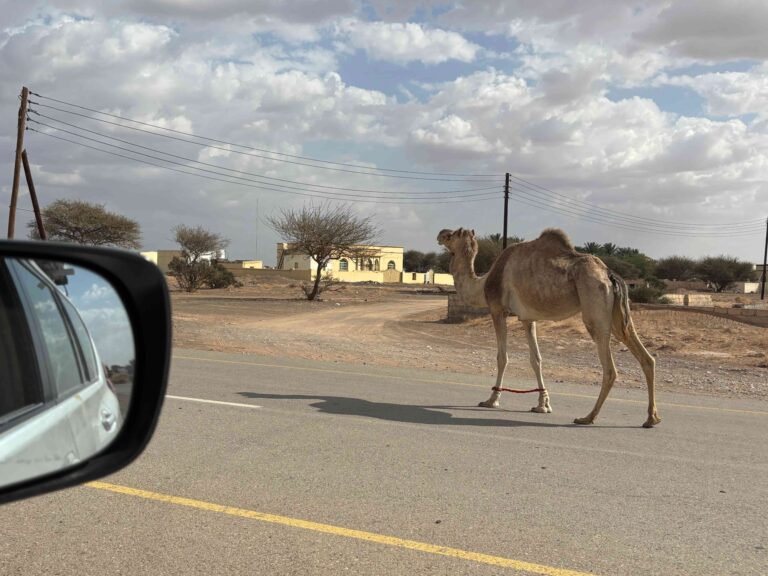
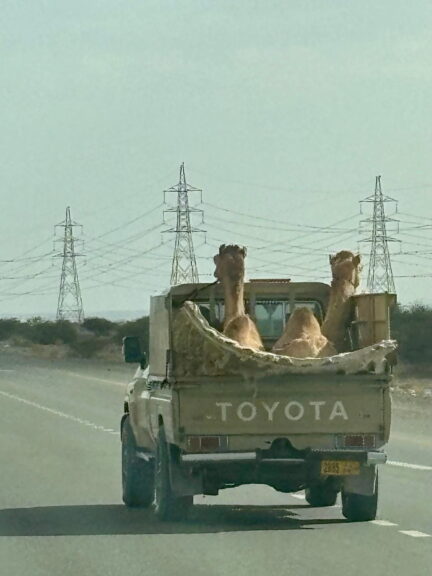
If you like roadtrips, then get ready for some epic driving:
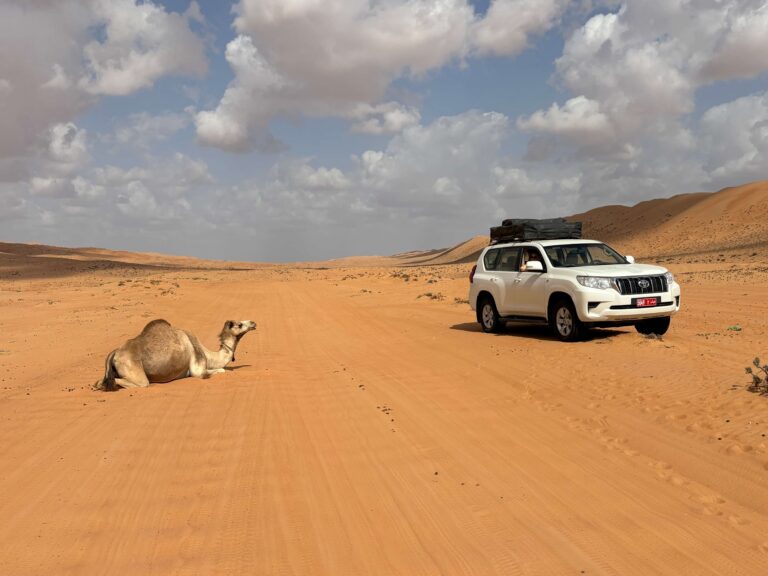
Self-driving and wild camping
For us it was more than worth it to pay a bit more in exchange for total independence. We could off-road, drive into the desert, along beaches, into the sand dunes…nothing was off-limits. Combined with the fact that we could just keep driving until no one else was around and wild camp almost anywhere, it’s by far the best option for Oman – as long as you feel comfortable with the drive itself and with being alone in isolated areas.
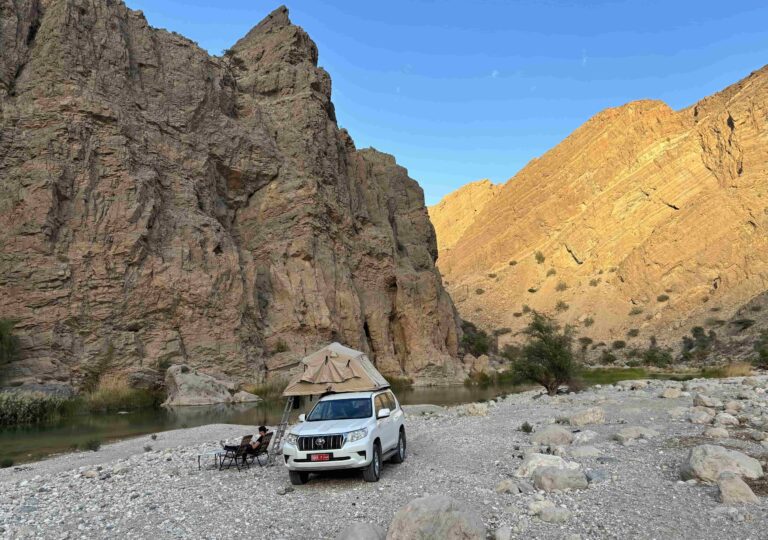
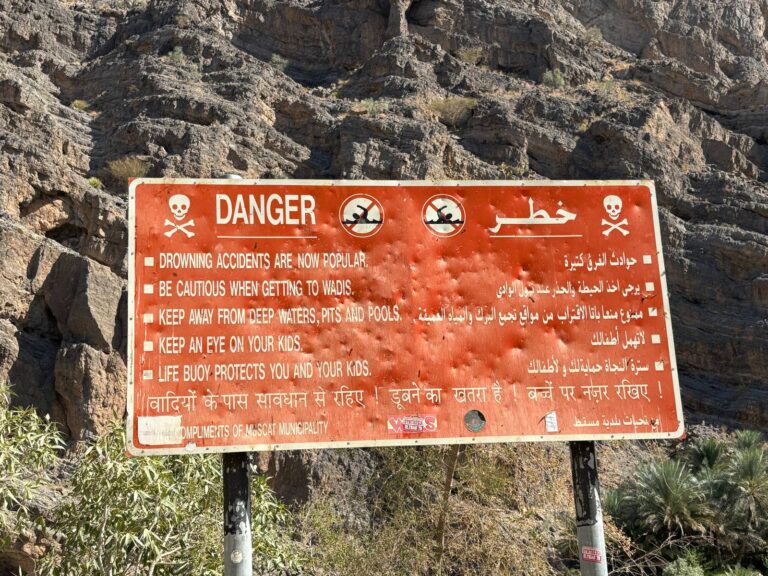
A side-note about camping in wadis, which are essentially dried-up river beds: if it rains, wadis are susceptible to sudden flash-flooding. Don’t camp directly in a riverbed, even one that’s currently dry.
If you decide to hire a 4×4 car to road trip and camp in Oman, here are some things you’ll need to think about:
- Booking your car. Many companies hire cars with camping equipment included. Unlike some of our other roadtripping destinations – hiring a car in Oman is easy, and it’s all official (as opposed to other rentals we’ve done where we just handed over hundreds of USD in cash, took the keys and drove off). We contacted about five companies to compare and they were all quite similar. During high season vehicles will book right out – you should organise this in advance. We travelled in January and booked the car about two months ahead of time. You also don’t really want to go outside of high season because of the weather – camping in the Middle East in the summer is no fun.
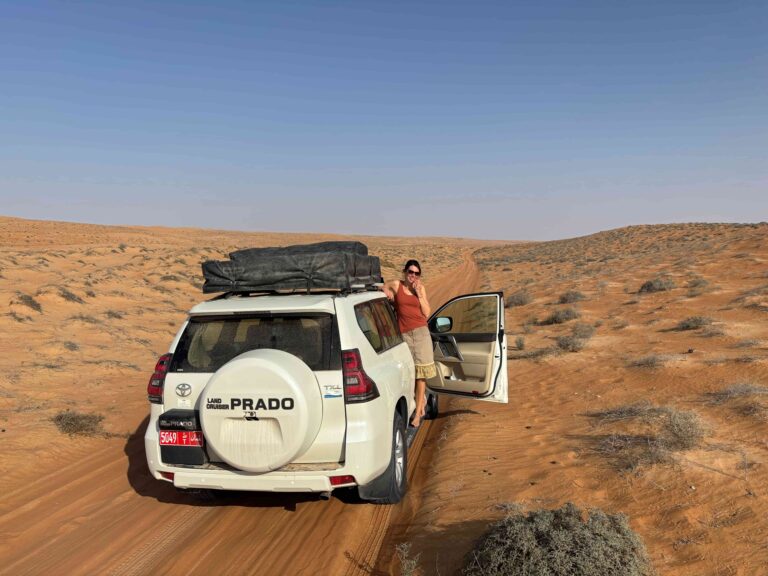
- It’s not cheap but it’s not expensive either. You can expect to pay around 180 USD/day for a decent vehicle in high season. Plus fuel, which OTOH is cheap. However, that’s your transport and accommodation in one go. A Toyota Prado was perfect for us (two people) with the space to carry all our gear and food.
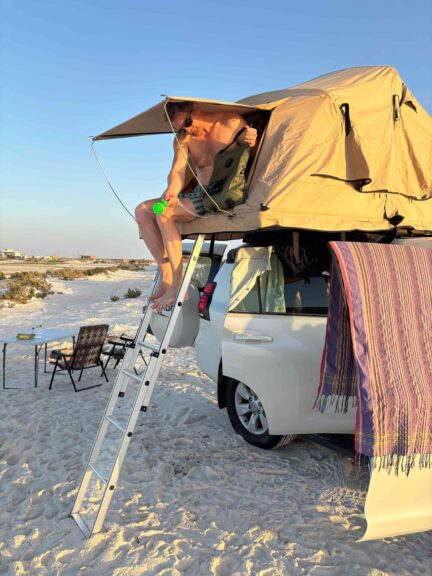
- Accommodation. Roof-tent, problem solved. In Oman you can camp practically anywhere as long as it is not private land or right next to a place of worship. iOverlander is a great resource for finding campsites – by campsites I mean, any spot where you can pitch your tent. On iOverlander you’ll find descriptions that people have written mentioning road conditions, vehicle accessibility, the view, shade, and so on.
- Insurance. In addition to our own regular travel insurance the car came with insurance included. Make sure you know what’s covered and what’s not.
- Mileage. General included mileage seemed to be 200 km a day so for our 12 day trip we had 2400 kilometers to burn. This was plenty – we ended up driving 2200 of them, and never once found ourselves counting kilometers before driving off into the distance. Going over the limit is usually a pretty nominal amount per km, just be clear on it ahead of time.
- Your rental company. Make sure to find out how they respond in case of any problems you might have on the road – assistance in a breakdown, towing or replacing vehicles, and so on. Get contact details. Ours had a WhatsApp group that all drivers could join and there was a lot of chatter in there with people suggesting places, routes, campsites, and in the event of car trouble – advice.
- Collecting the car. You’ll pay the total up front and fork over a refundable deposit as well. We paid cash in Omani rials. Make sure the registration papers are in the car. We never met police at any time and plenty of foreigners are driving around the country all over the place.
- Fuel. Outside the northern loop, top up the tank whenever fuel is available. Stay as close to full as possible when driving south and/or into the desert. Fuel is cheap and we could pay for it with card almost everywhere.
- Road conditions and traffic. In and around Muscat the roads are big and smooth. Basically, other than off-roading obviously – the roads are great.
- Driving. Consider your driving skills. Roads are great and you don’t have the whole crazy drivers of the Middle East experience, but once you go off-road you want to be confident in handling your 4×4. Especially in sand, whether desert or beach. You’ll need to deflate and re-inflate your tires from time to time depending on the sort of road you’re driving on – you can do this at any service station. Check with your rental company about recommended tyre pressure on various surfaces.
Before you go – planning your trip to Oman
Oman’s an easy destination. There isn’t a lot to think about besides enjoying yourself – which is nice because in our case we were coming from Iraq and hadn’t put a lot of thought into things like which sand dune to camp in. Still, it’s a good idea to at least rough out your itinerary so you don’t waste time – which is where this post comes in. You can borrow whatever elements of our itinerary you like, and hit the road. This was a smooth trip and we definitely felt like we made the most of our time in Oman.
We spent a day in Muscat, picked up the car the next morning, and off we went. We wild camped every night so other than the first night in the city, we had no hotel bookings whatsoever.
Remember, if you’re going between November and March, book your car at least two months in advance because they do get booked out in the high season.
When to go
Oman has a distinct tourist season, around October to March. Outside of those months the heat is pretty insane. But even in the high season we found it pretty easy to drive off and find our own space to camp. And outside of tourist sites on the northern loop (towns like Nizwa, hotspots like Wadi Shams) it was pretty chill.
The seasonal exception is the far south, around Salalah. That part of the country is best experienced during the Khareef (monsoon) season, from late June to early September, when the whole area is really lush and green. We considered driving all the way to Salalah during our twelve day trip, but decided against it. Reaching Salalah takes a long day (like, ten hours) of driving south, plus either the return drive or a flight back to Muscat (and a one-way rental).
Since we were there in January which is not the optimal time for Salalah, we drove as far south as the Sugar Dunes.
How many days for a roadtrip in Oman?
Before you book your car you should sort out your itinerary and figure out how many days you need. We ended up renting the car for twelve days to drive the northern loop and on south to the Sugar Dunes, which with driving here and there as we wanted, worked out to about 2100 kilometers.
Overall, our trip was a good relaxed mix of desert, beaches, old fortified towns, wadis, nature and civilization. We moved almost every day which is easy to do since the distances in northern Oman are fairly short and we rarely had long driving days. With the tent easy to set up on the roof, this was perfect for us and we never rushed at all. Further south we had some time to play with and we spontaneously spent an extra night at ‘the Maldives of Oman’ (see days 6 and 7 in this post) because it was too beautiful to leave. Highly recommend leaving yourself at least a day or two of flexibility for this kind of thing.
To add on Salalah, you’d want at least another four or five days. To make a shorter trip, you can plan for the northern loop only. See days 1-4 and 10-12 in our itinerary about that.
And there are things to do in and around Muscat so you might want to spend a day or two there on the start or end of your road trip, as well.
Things to bring (and useful apps)
- Just a little cash. You can use card almost everywhere. We didn’t even encounter a situation where we couldn’t use card. We took 50-100 rials in cash from an ATM in Muscat, just in case.
- Powerbanks. You’ll probably be able to charge via USB in the car but a powerbank or two is a good idea.
- Flashlight. For night-time bathroom trips, if nothing else. Which reminds me: toilet paper.
- Food and water. Other than in Muscat, we cooked all our meals. We did a big shop at a Lulu Hypermart before leaving Muscat, and topped up here and there along the way. Lulus are pretty good and have mostly anything you want (except pork products). Pro-tip, the beef bacon at Lulu’s is good! But even small villages have basic supplies so no stress. We bought drinking water and kept a good stock of it. We had a jerrycan for washing water, and a camp shower on board. These we refilled regularly at mosques, which are plentiful and usually have a watertap right outside the entrance or in the courtyard. Speaking of mosques and drinking, Oman is mostly dry. If you want alcohol you can pick some up at the duty free in the airport on the way in, and that’s about it.
- Garbage bags. Pick some up at the hypermarket. As always when camping, you should leave nothing behind (and it seems other people have ignored this in the past so you may find yourself picking up other people’s garbage here and there). You can dump your rubbish at bins in any town you pass through.
- Gas bottles. For your campstove. These are easy to find even in tiny little stores.
- Camping gear. Check what’s included with your rental. A lot of them don’t include sleeping bags and you need to reserve these additionally for a small fee. We definitely needed them, in January. Our rental came with the roof tent, mattress, sheet and pillows, table and chairs, stove, and basic crockery set. We occasionally bought firewood, more often we just foraged it.
- Fridge. Another extra I’d highly recommend adding on as opposed to just using the included cooler. If you’re going to carry and cook food, book a fridge with your car.
- Warm clothes in layers. Obviously depends on time of year but we had chilly mornings and evenings.
- Toolkit. This, and a spare tire, should come with your car.
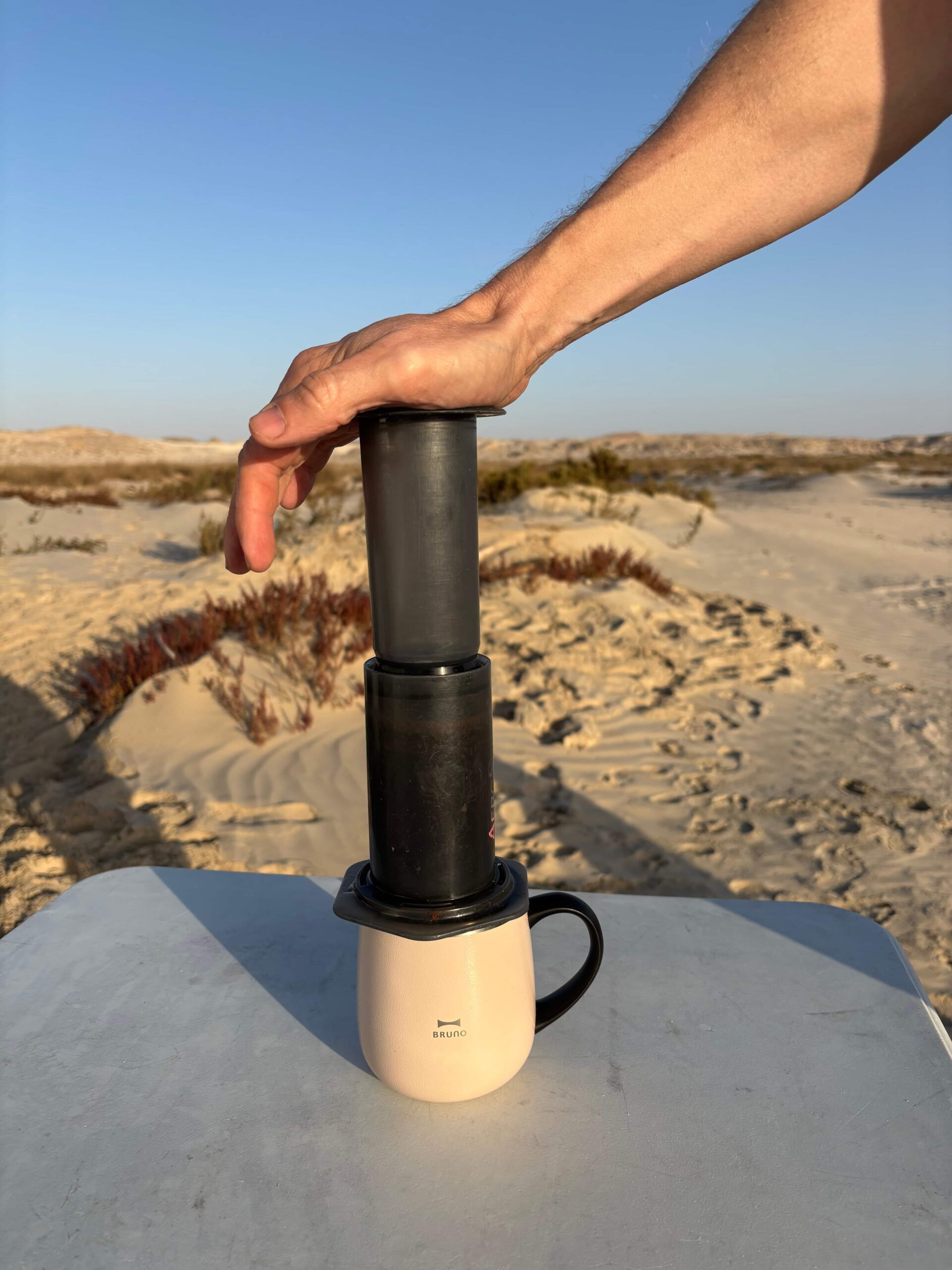
- And, super important to us at least: we are coffee lovers and always travel with an Aeropress to easily brew good coffee on the road.
- Maps.me is indispensable. It has great off-roading track details and doesn’t run on your data. In addition to the actual route and off-road tracks, a lot of detours, stops, and campsites are marked on it. Google maps is fine for sealed roads.
- iOverlander. Super useful for following little lines in the sand to campsites that other overlanders already vetted with descriptions about vehicle accessibility, shade, proximity to a road, and so on.
- Google Translate and an Arabic dictionary for offline use. We didn’t need it but it doesn’t hurt.
Costs
Your budget should include the car, fuel, accommodation if you’re going for hotels or safari-type camps, and food on the road. For us it worked out like this:
- Toyota Prado with camping gear. 180 USD/day.
- Fuel. We spent a total of about 220 USD (0.6$ per litre) on fuel, including a final top-up before returning the car.
- Food. We spent about 275 USD on food, basic supplies, drinking water, gas for the cookstove. We don’t like to cut corners there so we bought all kinds of nice stuff and cooked two or three good meals a day.
- Entrance fees, incidentals. Depends what you’re doing but you probably won’t encounter a lot of entrance fees other than at the occasional fort, unless you are obsessed with forts. Incidentals are up to you – for us, this was mainly coffee at any decent cafe we came across (and there are many).
- Accommodation. We stayed in a couple of hotels in Muscat at the start and the end. Otherwise, we camped. Wild-camping is free! And fantastic.
Keeping in touch
- WiFi. Most cafes have WiFi, certainly any place you go or stay in Muscat. I assume some safari-type desert camps would too.
- SIM card. We had an Airolo eSim. This worked perfectly most of the time. Even in remote areas we usually had signal, or would go in out of range from time to time.
On the road in Oman – our itinerary
This post is about our experience self-driving in Oman and wild camping for twelve days. Feel free to lift out any parts that suit you and save yourself the planning. Here’s a map of our route. We started in Muscat, basically drove a northern circuit, then took the plunge south, and back up to Muscat through the desert and then along the coast:
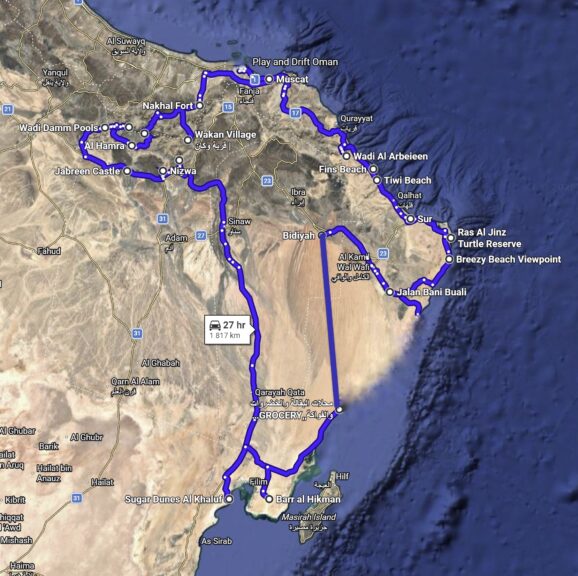
The map shows an outline of the route as in our Oman itinerary below. You’ll find links to the locations we camped at, in the section for each day.
DAY 1 – Muscat > Nakhal Fort > Wakan Valley
DAY 2 – Wakan Valley > Bald Sayt > Al Hamra
DAY 3 – Al Hamra > Jebel Shams > Wadi Damm
DAY 4 – Wadi Damm > Nizwa > Wadi Muaydin
DAY 5 – Wadi Muaydin > Al Khaluf/Sugar Dunes
DAYS 6 & 7 – Al Khaluf > Sugar Dunes > Mahoot > Barr Al Hikman
DAY 8 – Barr Al Hikman > Mahoot > Wahiba Sands
DAY 9 – Wahiba Sands > Breezy Beach viewpoint (near the Ras Al Jinz Turtle Sanctuary)
DAY 10 – Breezy Beach viewpoint > Khalid beach > Sur > Tiwi Beach/Wadi Shams
DAY 11 – Tiwi Beach/Wadi Shams > Wadi Al Arbeieen
DAY 12 – Wadi Al Arbeieen > Seeb (Daymaniyat Islands) > Muscat
DAY 1 – Muscat > Nakhal Fort > Wakan Valley
Kilometers: 135 | Driving time: 1 hr 45 min
We picked up the car in Muscat at 10:00 and did some (ok…a lot of) grocery shopping at a Lulu Hypermarket. For me that’s half the fun. Then we officially started our trip, heading for the ‘Rustaq loop’, a kind of circuit of forts and wadis not far from Muscat. This is part of the northern circuit I’ve referred to above, that you might do as a standalone trip if you only have a couple of days or are driving a regular car.
The start of the Rustaq loop is Nakhal Fort, about 90 km from Muscat.
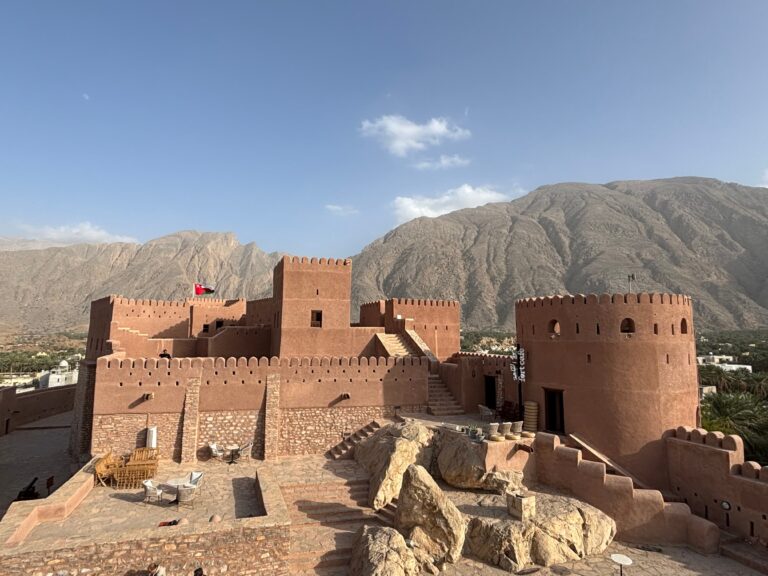
The fort itself is not incredibly exciting, but the surrounding oasis and mountain views are beautiful. Since it was getting dark when we left the fort we decided to camp in Wakan Valley, a 45 minute drive away. It was windy so we camped in this sheltered spot.
DAY 2 – Wakan Valley > Bald Sayt > Al Hamra
Kilometers: 130 | Driving time: 5 hrs
This was a sort of scenic-driving-with-stops-and-walks kind of day.
After breakfast we drove up to Wakan Village and did a half hour village walk along the irrigation channels, ending up at a viewpoint overlooking the valley. There’s good coffee in this tiny village both in a cafe with amazing views, and, along the way at a little ‘honor system’ stop on the walk.
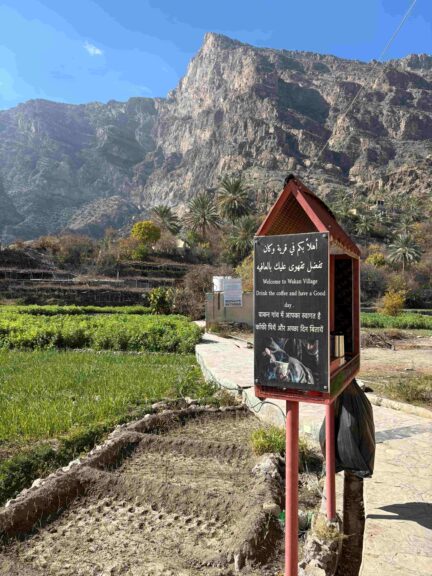
From Wakan Valley we drove to Wadi Bani Auf and stopped at Bald Sayt, a pretty mountain village. Along the way there you can stop and trek in Little Snake Canyon and Snake Canyon.
The drive to Bald Sayt is steep and unpaved (4×4 vehicle required) – it took about two and a half hours for 85 km. It gets even steeper when continuing toward the village of Hatt and up to the top of Jebel Hatt. From the Jebel Hatt viewpoint onward, the road is paved.
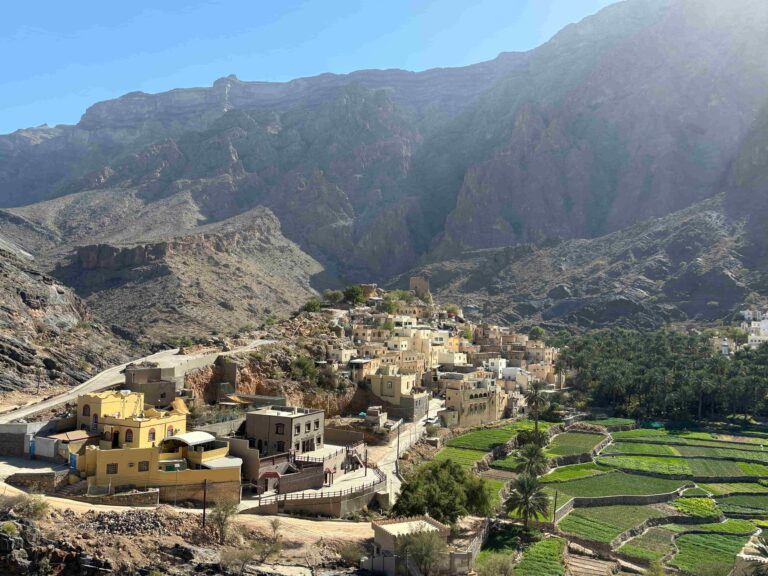
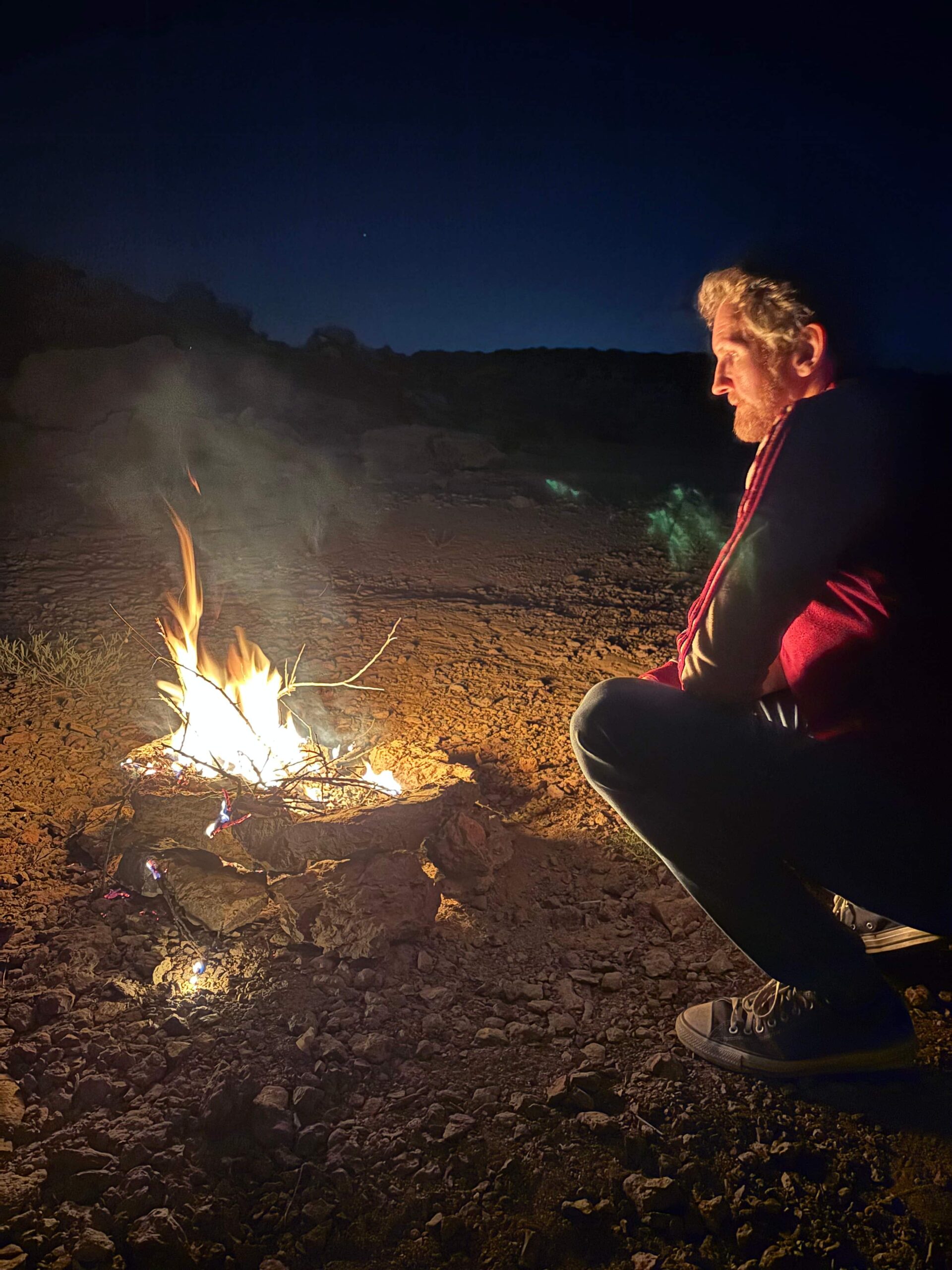
We carried on to Al Hamra which is around 40 km and it took about two hours. We camped a few kilometers before reaching Al Hamra, at the foot of the Hajar Mountains, here:
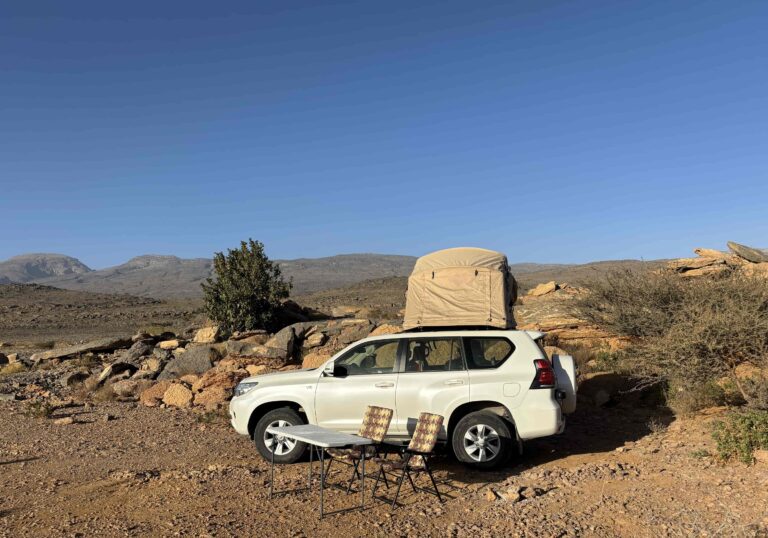
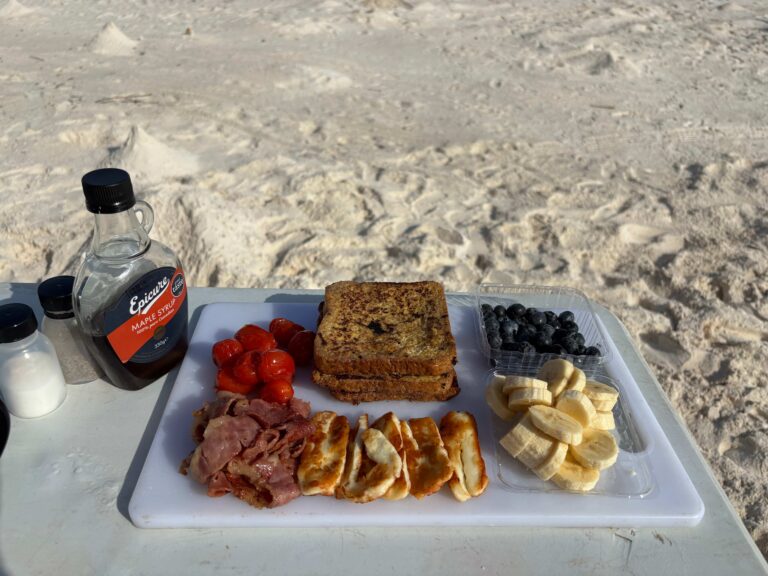
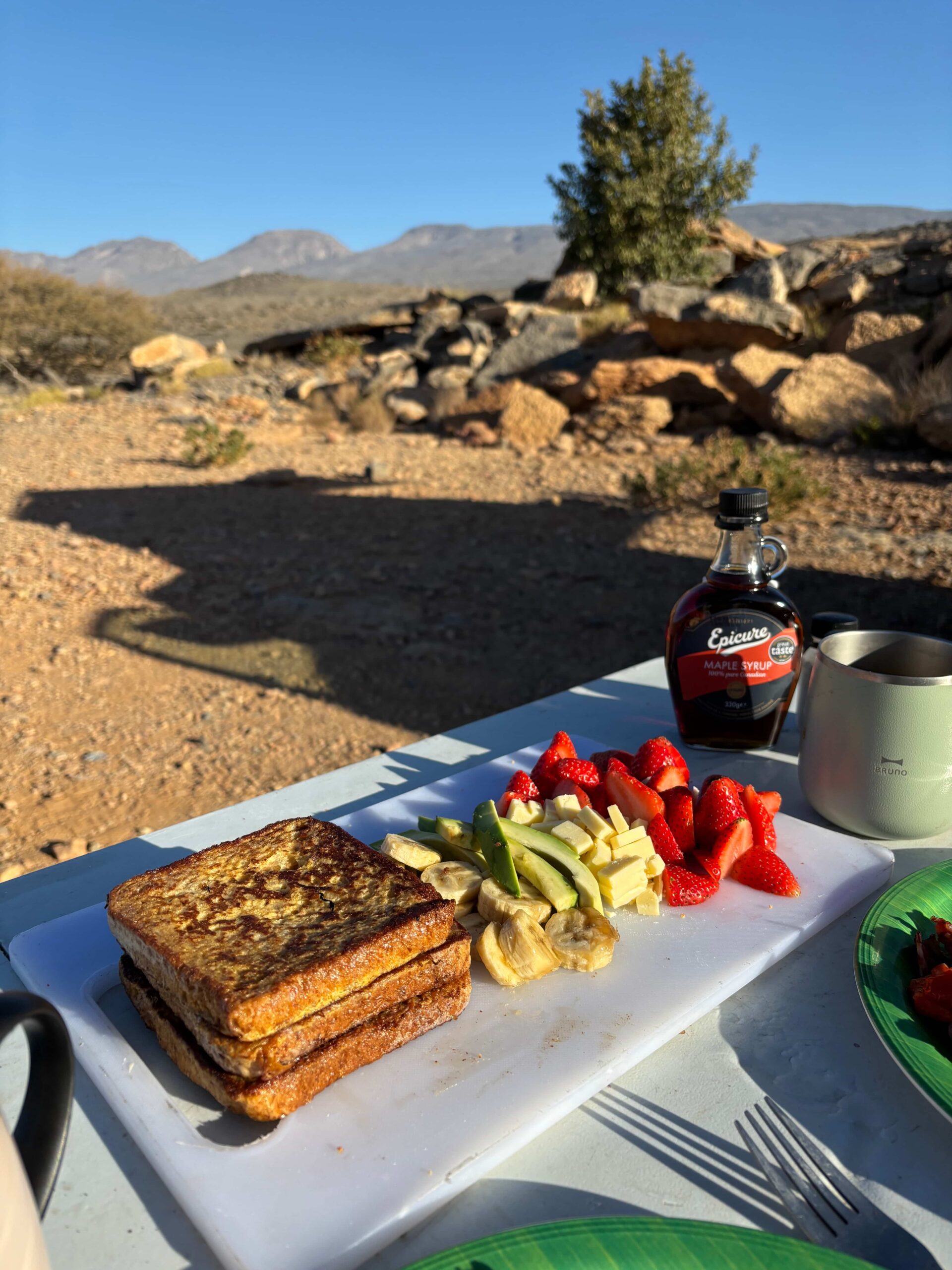
We built our first campfire of the trip, and in the morning made a killer breakfast:
DAY 3 – Al Hamra > Jebel Shams > Wadi Damm
Kilometers: 80 | Driving time: 2.5 hrs
We started the day at Al Hoota Cave, a short drive from Al Hamra. For me, in retrospect: hard pass. Designated walkways, organized tour, nothing special unless you are especially interested in stalactites or travelling with kids.
Then we drove to Al Hamra to explore the old village. Parts of it are a crumbling mud-brick settlement, other parts have been restored. The Bait Al Safah Museum in the former governor’s house, is good – there is actually more to learn about dates than you might think.
Then we continued to Wadi Ghul and up to the top of Jebel Shams. At the entrance to Wadi Ghul, there’s a viewpoint overlooking the wadi and the beautiful stone houses right across the valley.
From there it’s about a 45-minute drive to the summit, where you get dizzying views of Jebel Shams and the canyon.
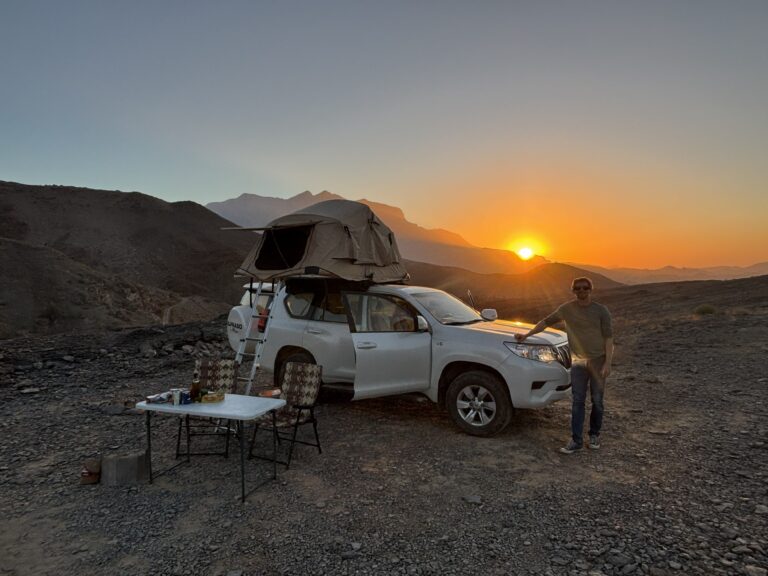
We camped in Wadi Damm, not far from Jebel Shams in a stony and secluded campsite:
DAY 4 – Wadi Damm > Nizwa > Wadi Muaydin
Kilometers: 150 | Driving time: 2.5 hrs
This morning was super nice: we walked into Wadi Damm along the dry and rocky riverbed in the early morning sun.
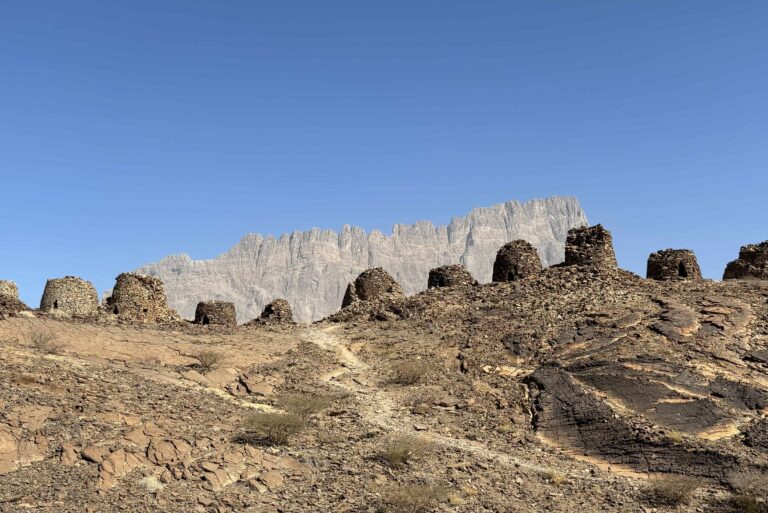
After breakfast we drove toward the Al Ayn Beehive Tombs. Definitely stop here, they’re just rocky tombs standing on a hill and you can scrabble around, probably all alone.
After this we had two choices: Jabreen Castle or Bahla Fort. We went with the castle for a change and we found it more interesting than Nakhal fort (and Nizwa, which we went to next, hence the decision in the first place). Seriously, choose your forts wisely, there is not exactly a shortage here.
So then we drove on to Nizwa. If you happen to be there on a Friday morning between 07:00 and 09:00 you could check out the animal market, especially if you’ve never seen one before. Nizwa is the biggest town in the area and there’s a big frankincense-scented-souq of course.
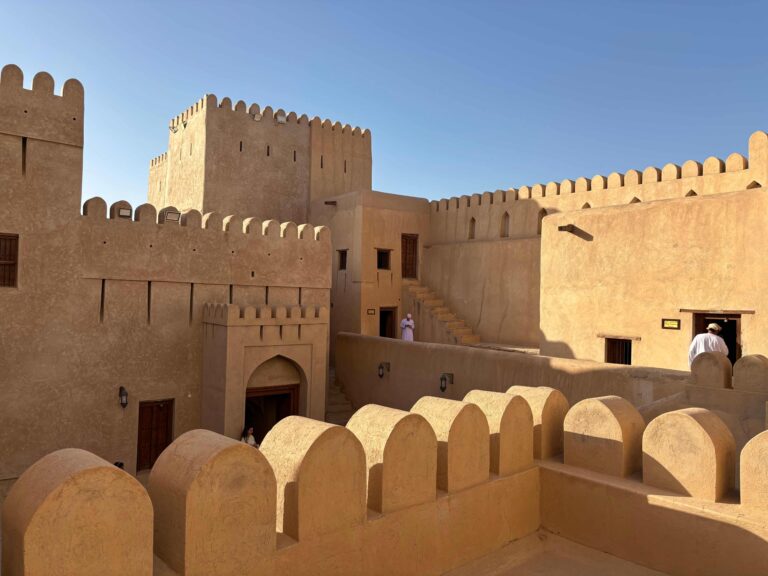
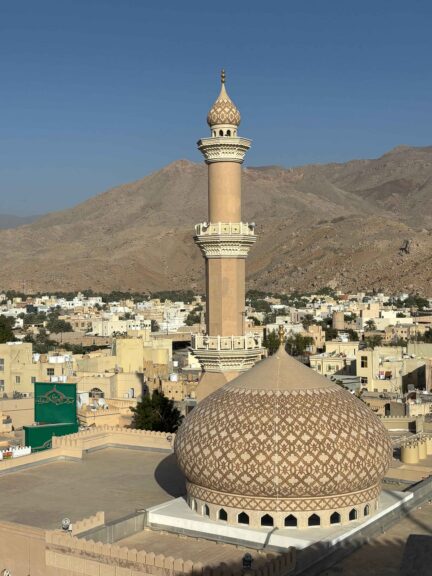
Nizwa Fort is particularly photogenic in the late afternoon with the mosque as a backdrop, and so there are a lot of dressed-up women posing and patient men clicking away. You’ll have to wait your turn…
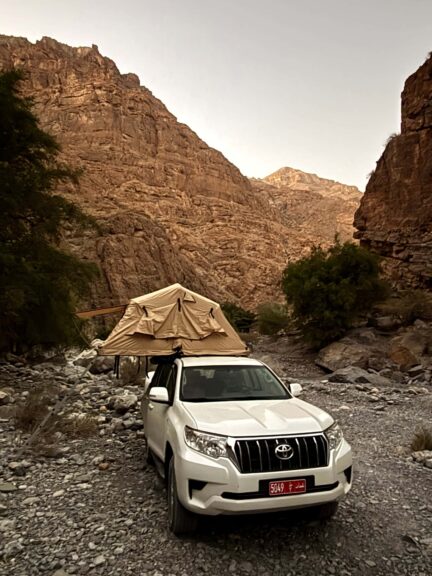
We had planned to camp near Diana’s Viewpoint (named for youbetcha who), but sunset comes early in January, around 17:30, so we didn’t make it that far. Instead we turned into Wadi Muaydin and camped near the end of the road:
DAY 5 – Wadi Muaydin > Al Khaluf/Sugar Dunes
Kilometers: 350 | Driving time: 4 hrs
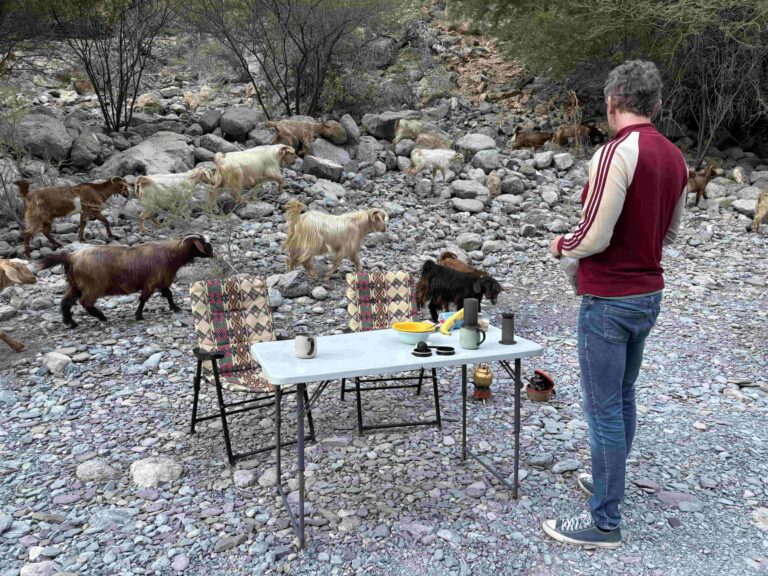
In the morning we breakfasted amidst a herd of goats that joined us at camp:
Even without going all the way to Salalah we still had a long drive south – about 400 km – to reach the Sugar Dunes. That took about five hours driving through dry, flat landscapes, and we only stopped when we managed to find a shady spot for lunch under a tree.
The road is paved all the way to the fishing village of Al Khaluf. We drove along the beach and camped at Khaluf Beach which was completely empty, although fishermen had been there at some point and fairly frequently. The beach is pretty but it looked like some kind of wholesale fish slaughtering frenzy had taken place. We had to put on shoes and shovel sharp splintered fish bones, whole heads, and worst of all, huge multi-hook rusty lures, away from our site (yes, we tried moving first but it went on forever, seriously a whole net-full had washed up).
Once we cleaned it up a bit it was a perfect spot for us, windswept and pretty:
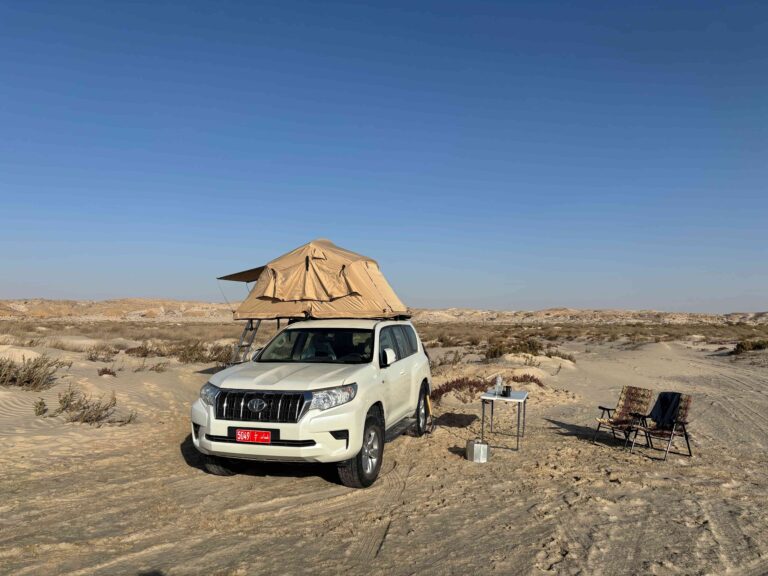
Side note, the beaches in general look very pristine at a distance but when you actually get on them, there is some serious rubbish. Expect a lot of plastic washed in with the tides. We cleaned up every beach site we camped at, and took away small mountains of flattened plastic bottles with us.
DAYS 6 & 7 – Al Khaluf > Sugar Dunes > Mahoot > Barr Al Hikman
Kilometers: 150 | Driving time: 2 hrs
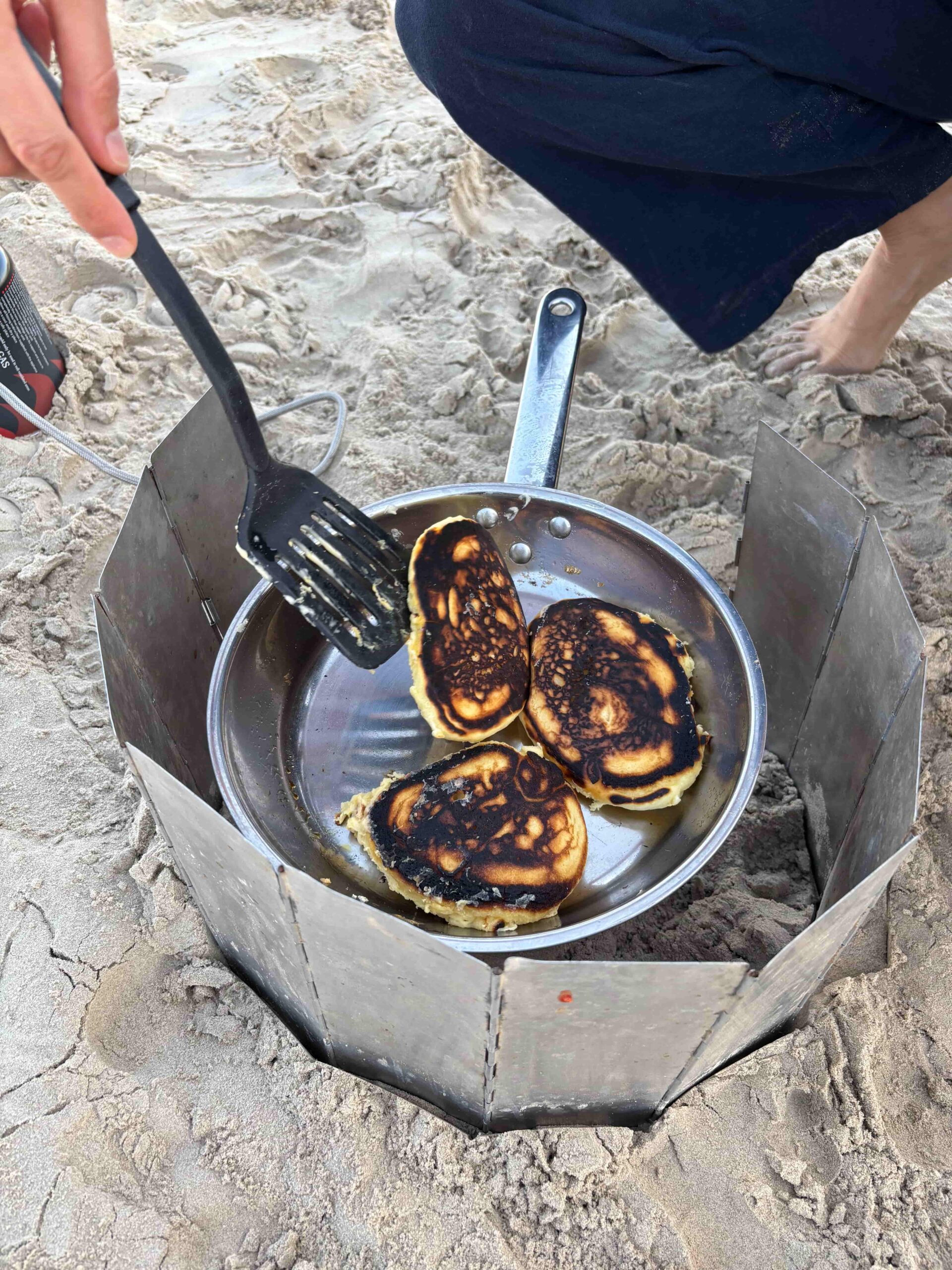
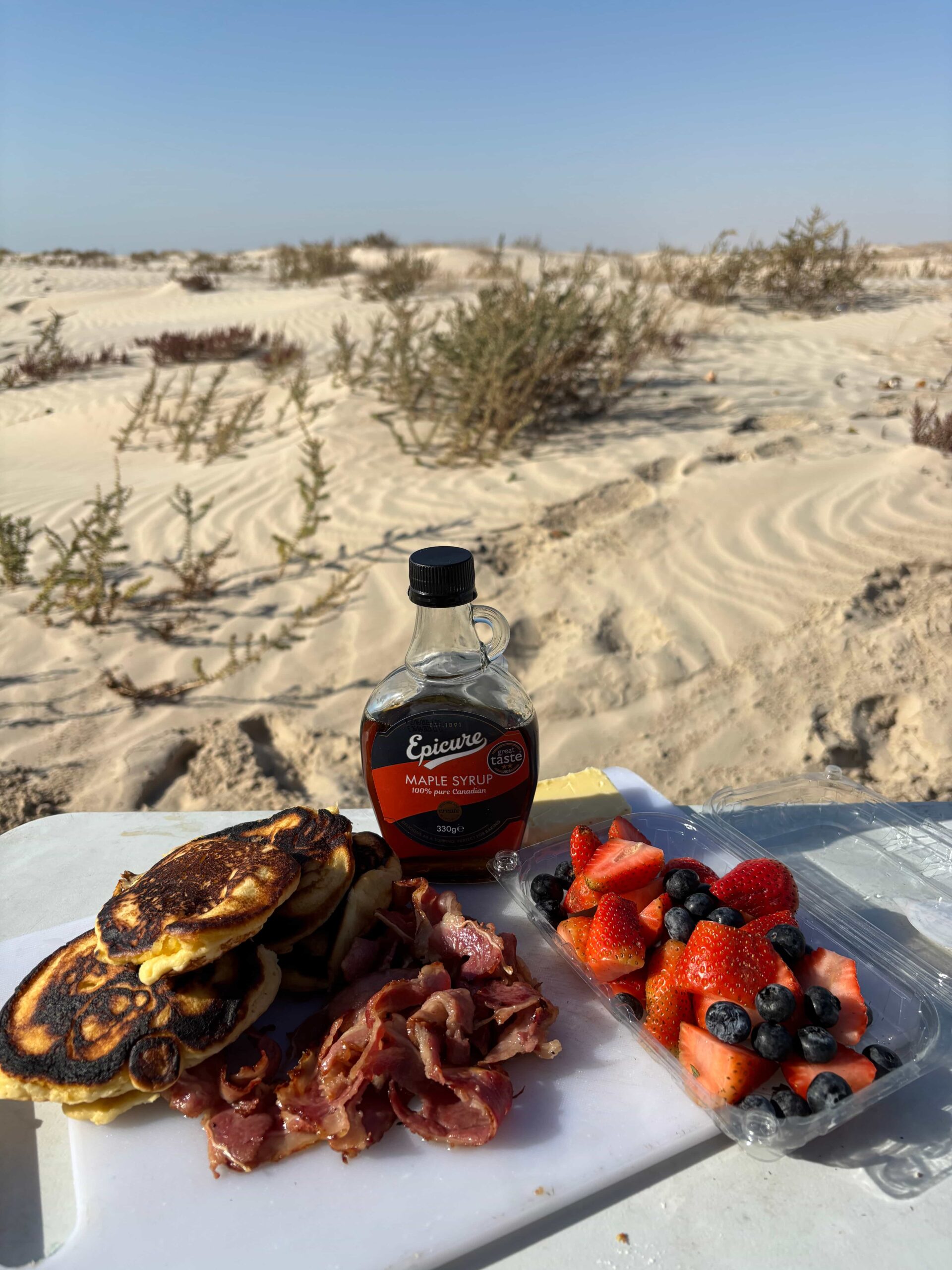
First things first, breakfast. I burned the pancakes just a bit, but overall (and with the coffee) it was a success:
Then we drove a bit further along the beach – always an excellent way to get anywhere – to the Sugar Dunes.
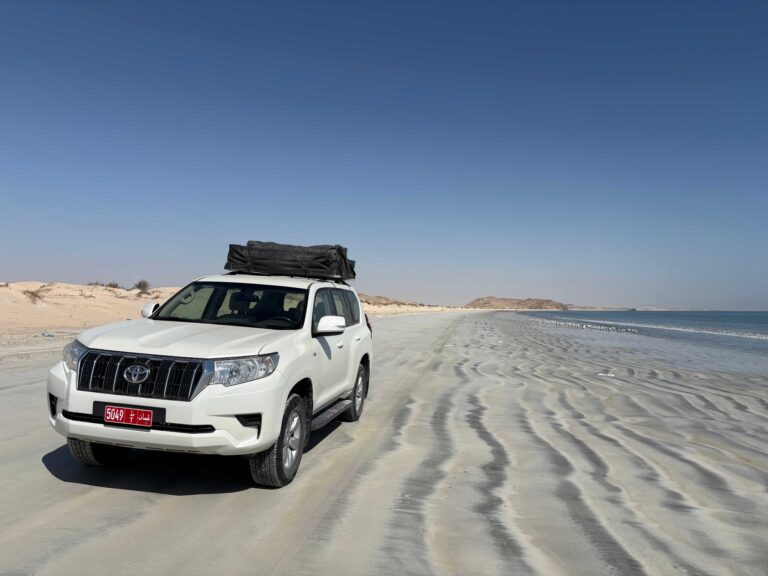
Although ‘busier’ (there are some camps and bungalow setups) the beach near the Sugar Dunes is nicer for swimming, and there were good camping spots in little coves along the way. The dunes themselves are amazing, with the whitest sand we’ve ever seen in a ‘desert’. In hindsight I’d just camp at the Sugar Dunes to see them at sunset and sunrise (especially if I was an early riser;))
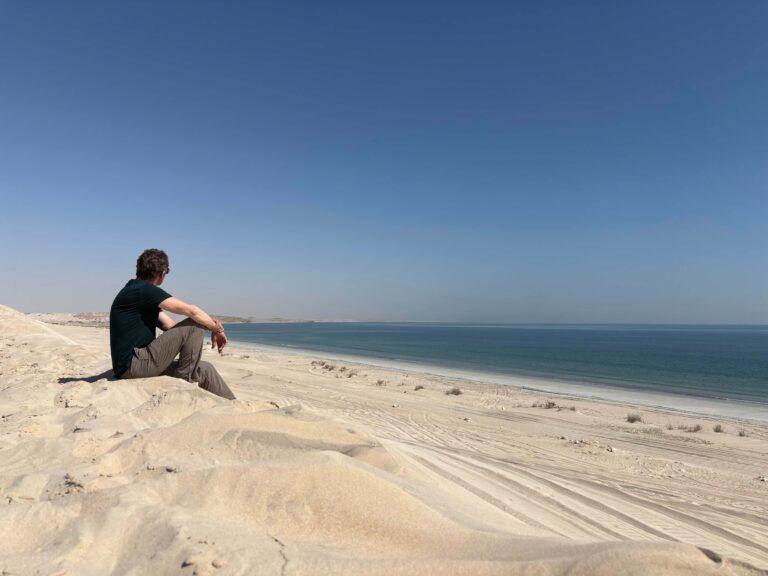
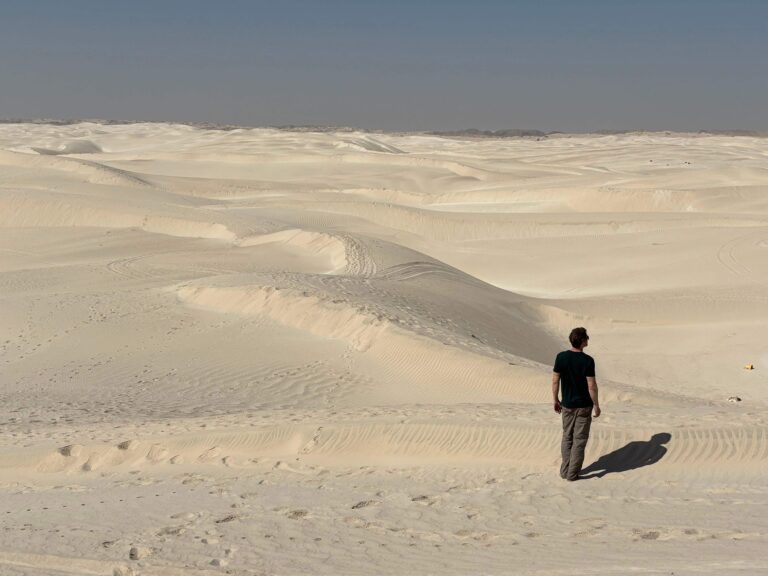
You definitely need a 4WD vehicle to drive along the beach from Al Khaluf to the Sugar Dunes, but we didn’t lower the tyre pressure and had no issues. Whether you sleep at the Sugar Dunes or not depends on the atmosphere you prefer but either way you should definitely drop by, climb up the dunes and look out at the white sand behind you and sparkling blue water in front.
After some more beach-driving and dune-running we drove about an hour to Mahoot where we stopped to lower our tyre pressure in preparation for the trip to Barr Al Hikman. From Mahoot to Barr Al Hikman takes about an hour and involves some easy off-roading on sandy tracks and eventually out onto the beach. Note that you’ll probably lose phone signal completely after Mahoot.
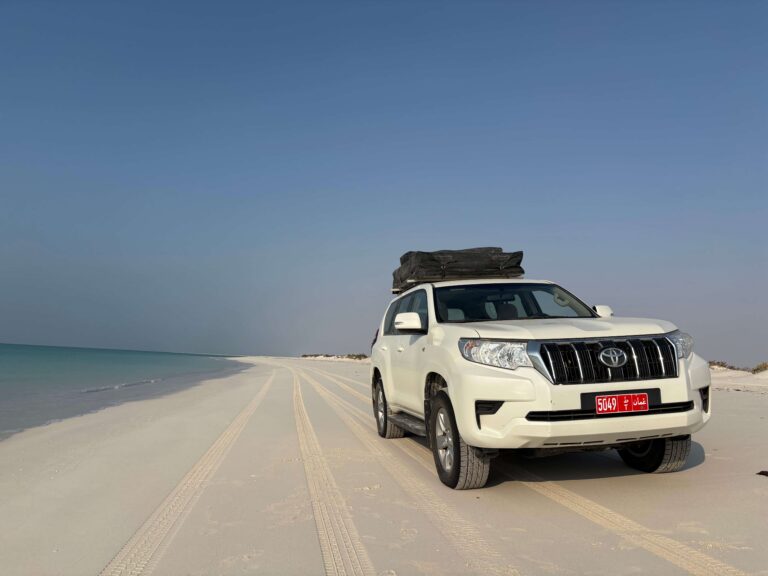
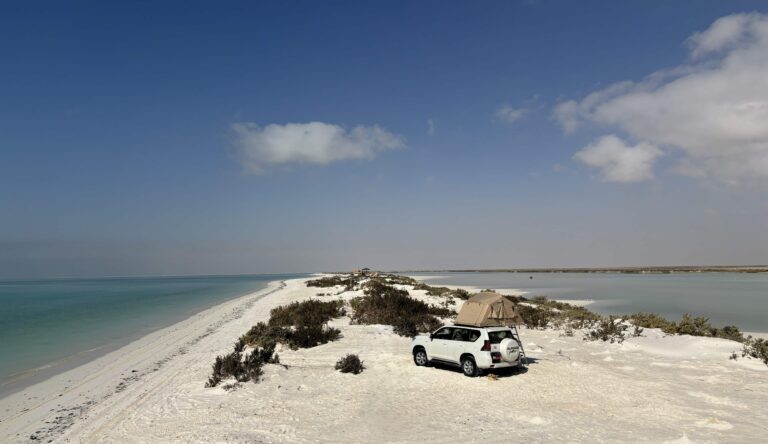
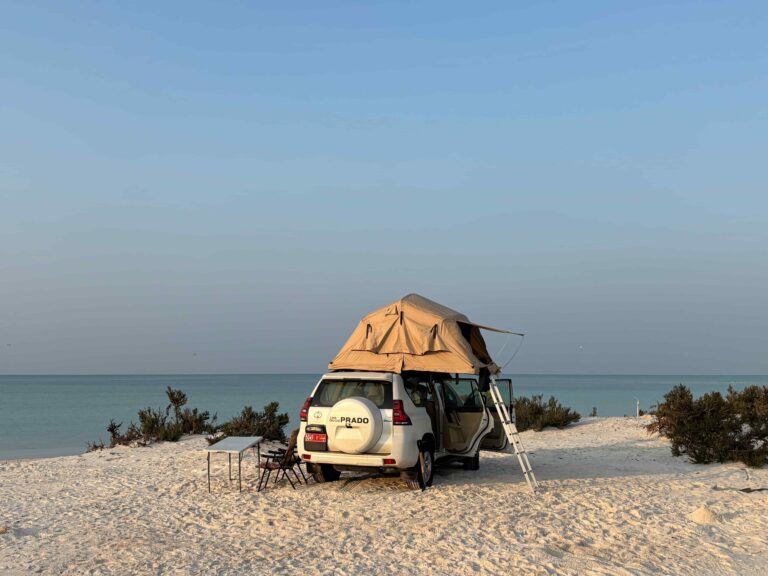
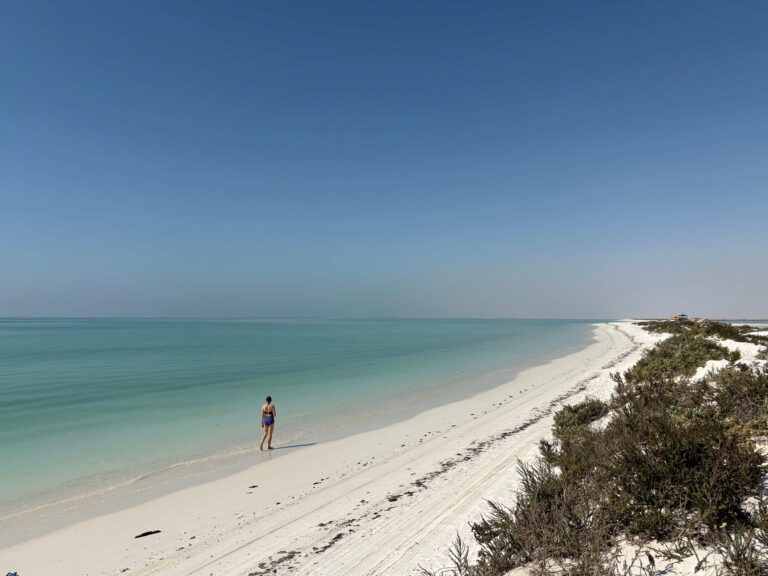
Barr Al Hikman – ‘The Maldives of Oman’ – is absolutely stunning. We set up camp on a little strip of sand between the ocean and a bird-filled lagoon:
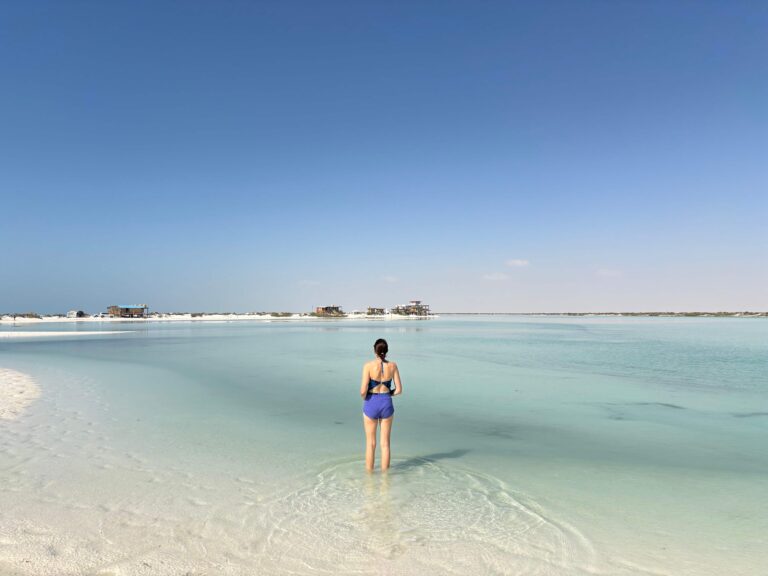
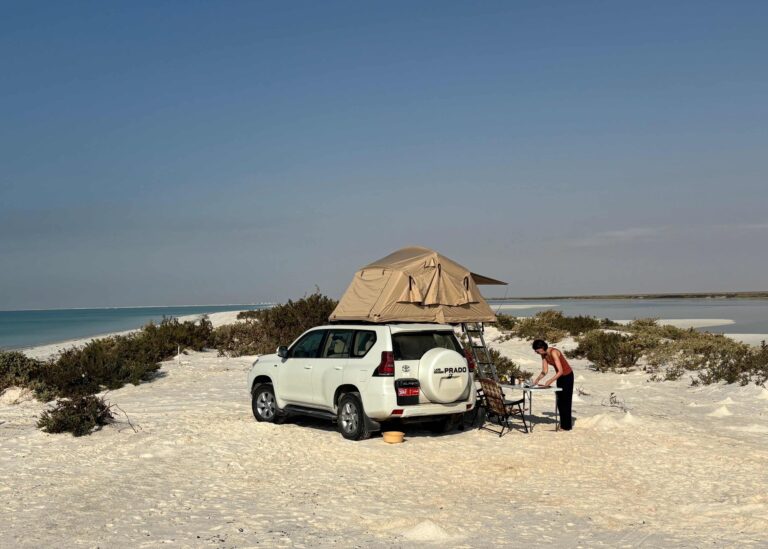
The next day we couldn’t tear ourselves away so we just stayed put for another night.
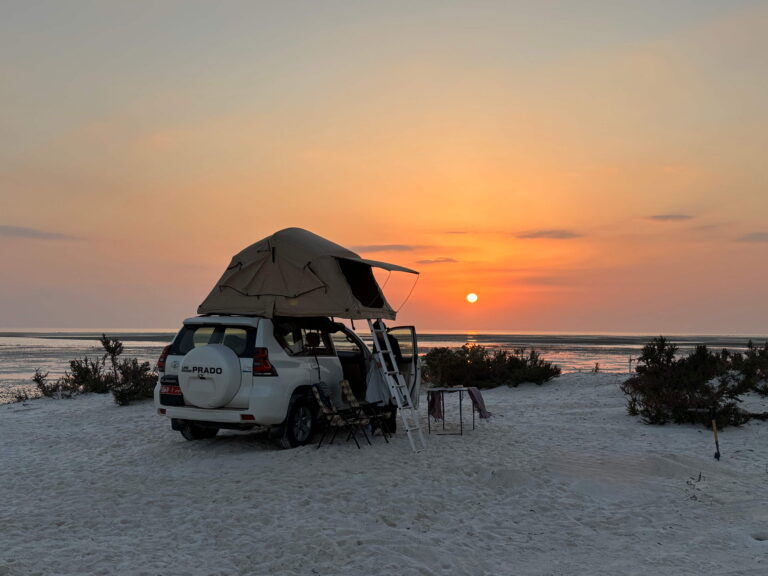
DAY 8 – Barr Al Hikman > Mahoot > Wahiba Sands
Kilometers: 345 | Driving time: 5 hrs
I’ll start this day with a friendly warning:
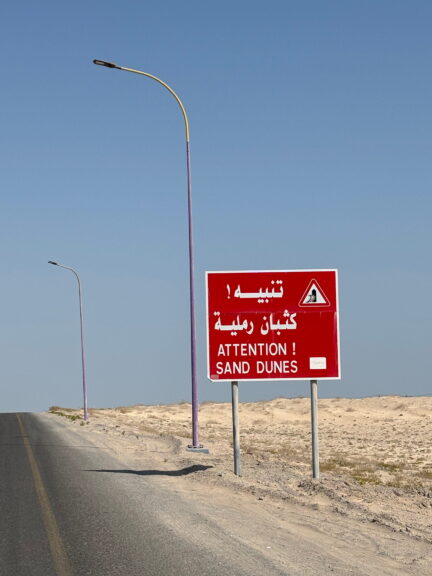
We came-to from our beach-induced comas and packed up camp. Apparently not quite done with sand, we decided to drive straight into the desert next so we headed back to Mahoot to get sorted with food and water (and coffee) first.
Our plan was to drive from Mahoot through the swath of desert called Wahiba Sands, to a town further north called Bidiyah. There is no mobile phone signal in the desert, so if you’re going to do this you need to download an offline map (or two) first, make sure that you are well-supplied with water, and fill up your gas tank.
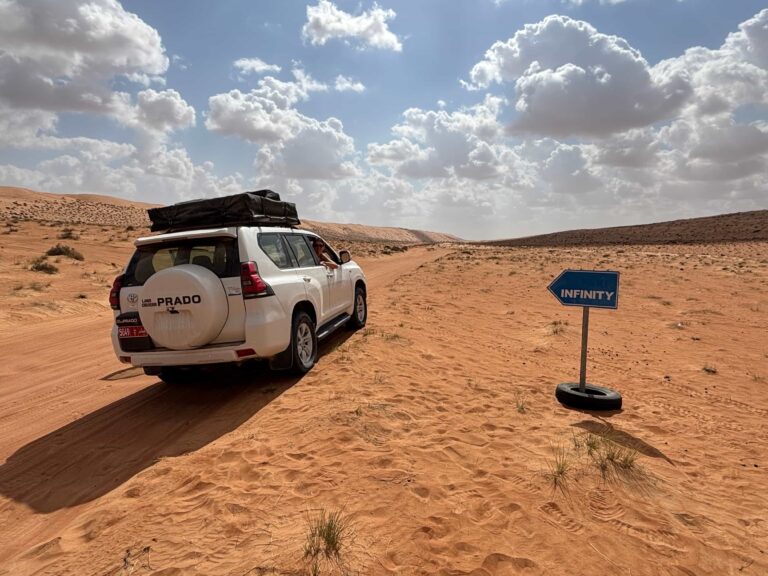
From Mahoot, it’s about an hour’s drive (100 km) to the southeastern entrance to Wahiba Sands. The entrance is in a little settlement, directly opposite Jamea Quhaid Mosque. The drive from the entrance all the way through to Bidiyah should take about four hours.
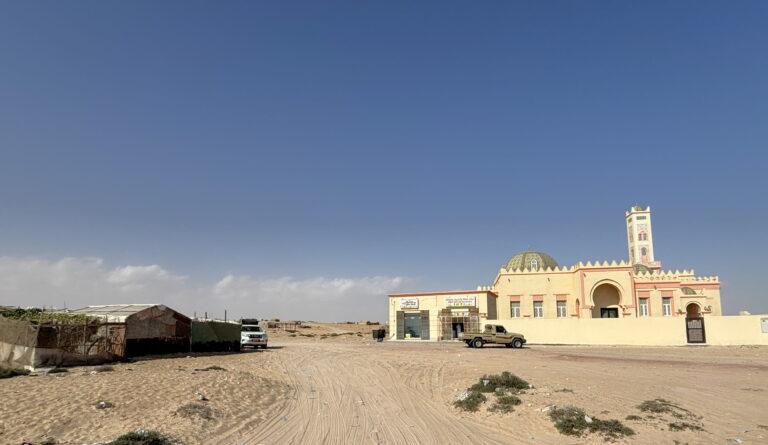
To the left of Jamea Quhaid Mosque there’s a small garage/shack where you should deflate your tires. Then you drive through the tiny village and onto the sand tracks, and off you go. Too easy, right? The sand isn’t deep and it’s pretty straightforward until you reach Al Kareem Mosque about two hours in, 55km.
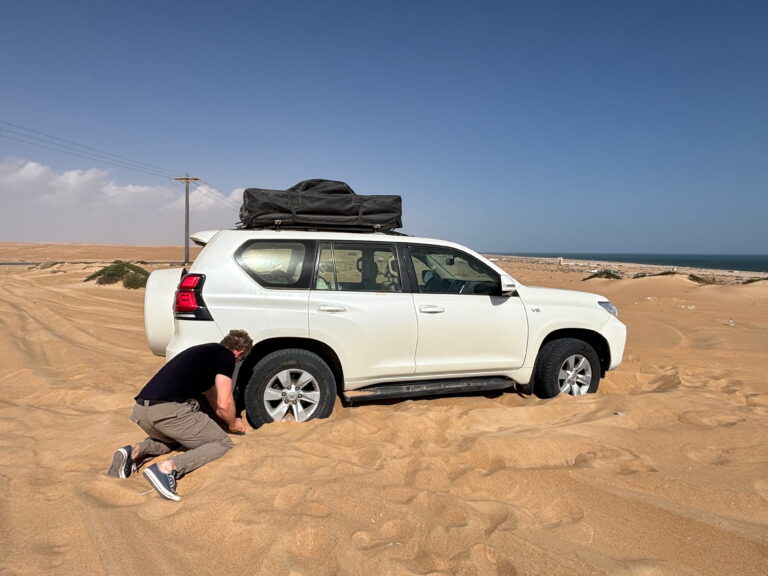
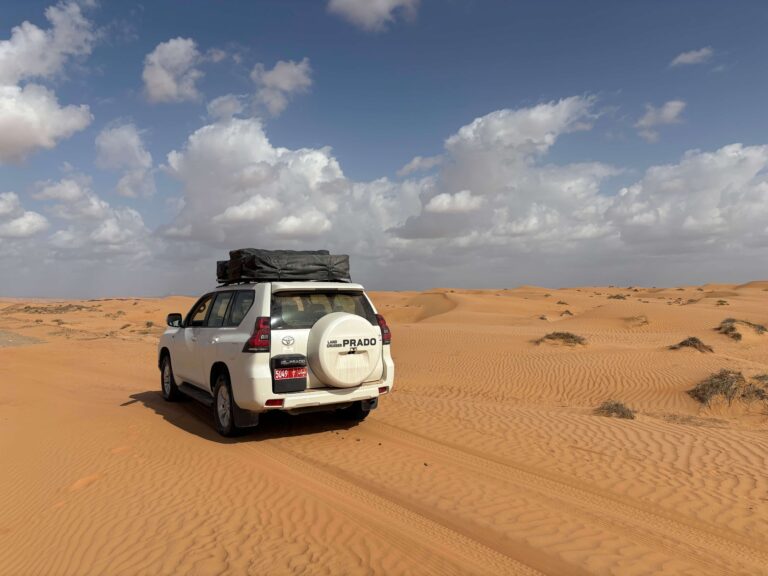
At Al Kareem Mosque several tracks branch off into different valleys with sand dunes rising on both sides and that’s where our GPS lost the plot and we lost the track. Then we wandered into the dunes by accident. Trying to get back, we got stuck deep in the sand and spent some time digging ourselves out (Oyv with the shovel, me with my hands).
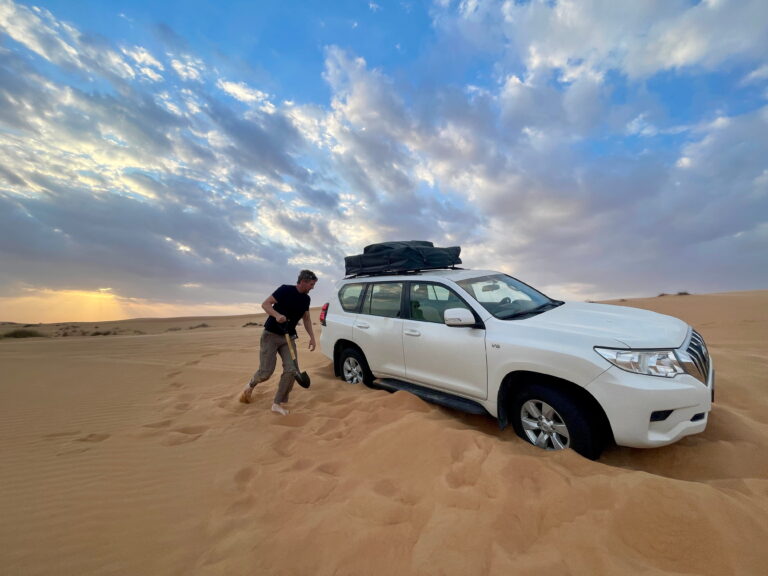
Considering we’d already got stuck in the sand and dug ourselves out earlier that very morning on the way from the Maldives when we thought we’d off-road a bit to find a nice stop for making PB&J sandwiches…we were well-practiced.
All this led to some unplanned dune-bashing as Oyv aggressively plowed the Landcruiser down the side of a dune in the hopes of building enough momentum to GTFO. Since I’m writing this you can rest assured that we did find the track again, but by then it was getting dark so we made camp:
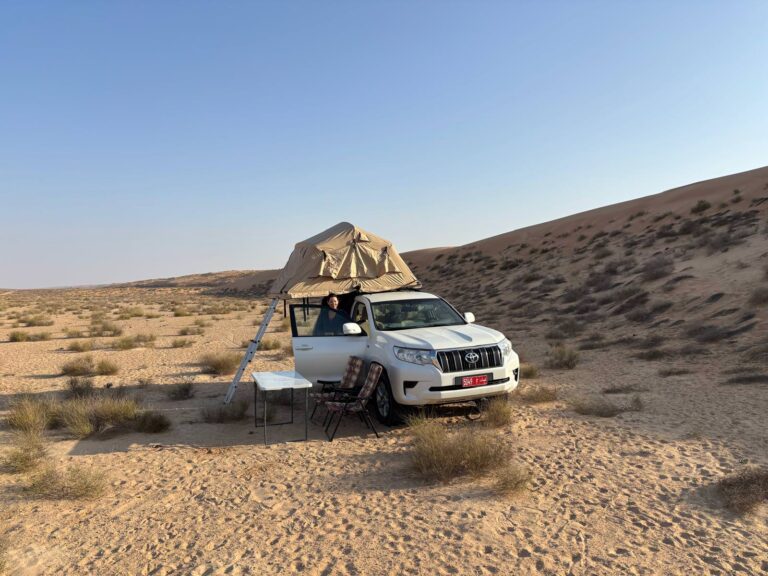
As I cooked us some noodles and both of us silently wondered if we had enough gas left, Oyv noticed a scorpion scuttling under our table and we put our shoes right back on.
Moral of the story: take it slow and don’t rely on just one navigation source in the desert. Maps.me is great and everything but when there are many overlapping tracks and it seems like yours on the map is dwindling into nothing, don’t follow it – just use your eyes – stick to well-driven tracks.
DAY 9 – Wahiba Sands > Breezy Beach viewpoint (near the Ras Al Jinz Turtle Sanctuary)
Kilometers: 315 | Driving time: 5 hrs
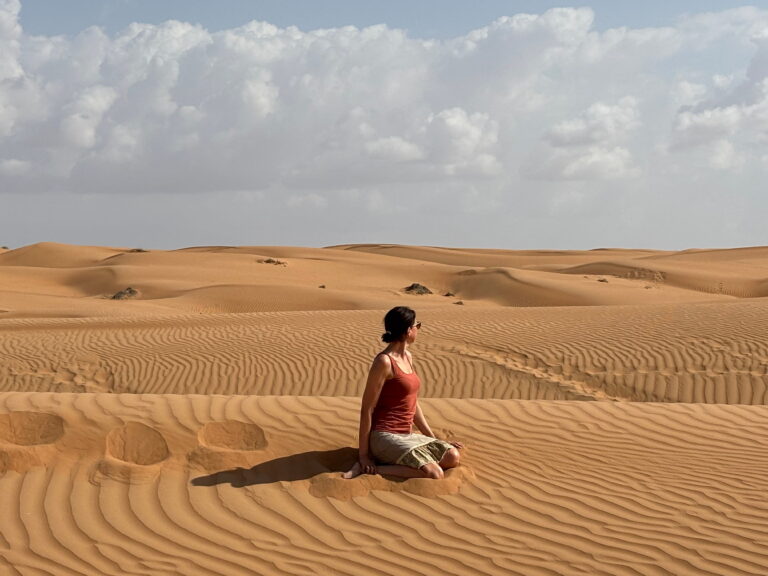
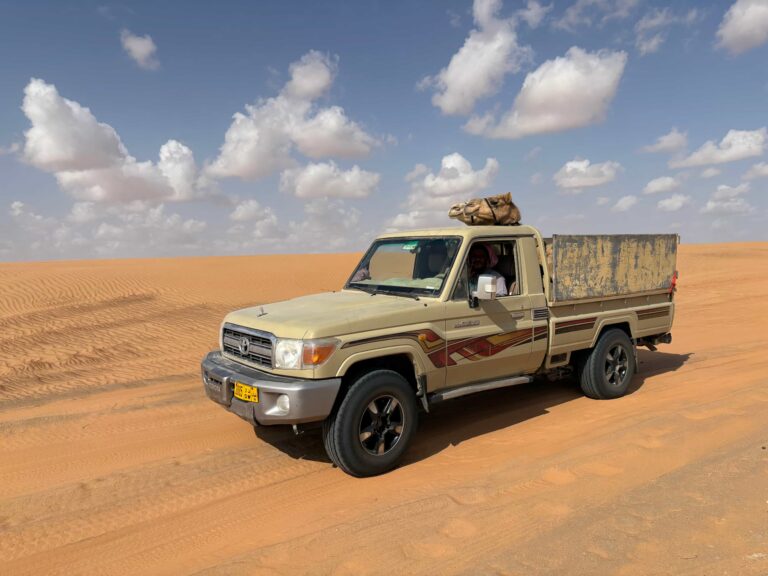
In the early morning chill of the desert we flagged down some passing Bedouins to ask if the track we were now camped next to would indeed lead us out. Without any of us understanding each other it nevertheless seemed like a positive interaction so we just left the car for a while and went climbing around in the dunes.
Afterwards, sticking carefully to a well-used track it took us about two more hours to reach Bidiyah.
We wanted to see turtles laying their eggs on the beach, but visiting on a tour can apparently amount to what sounds like animal abuse, with hordes of people gathered around a single female turtle sticking their phones under her shell while she’s just trying to lay her eggs in peace. So we gave that a pass and decided to try our luck spotting some ourselves.
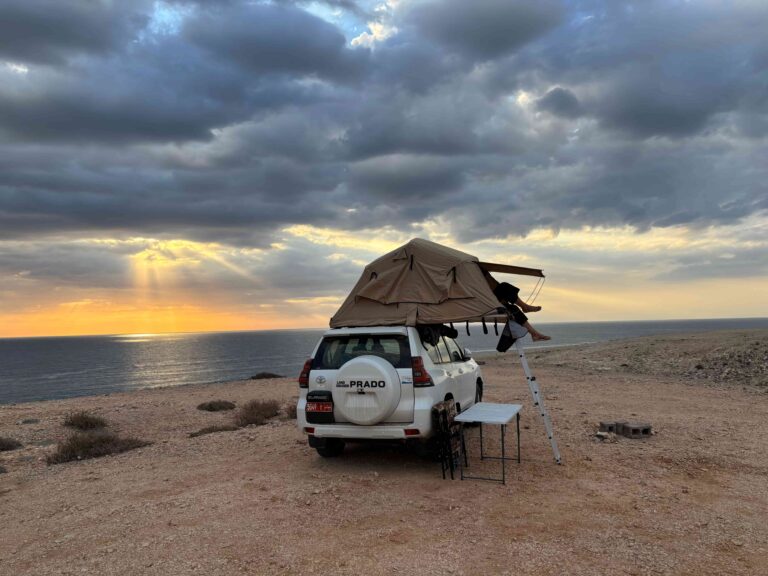
The drive from Bidiyah to the Breezy Beach viewpoint took about two and a half hours (160 km). We set up camp on the cliff overlooking the beach and then climbed down the rocks a few times during the night hoping to spot a turtle.
Wear a headlamp and good shoes, do not do this in flip-flops….but what do I know, I dug a Landcruiser out of the sand with my hands. We didn’t see any turtles unfortunately but we did find fresh tracks in the sand which was kind of cool.
DAY 10 – Breezy Beach viewpoint > Khalid beach > Sur > Tiwi Beach/Wadi Shams
Kilometers: 125 | Driving time: 2 hrs
By morning it was more than just breezy at our viewpoint campsite so we headed to nearby Khalid beach to make breakfast without getting blown off a cliff. Then we drove to Sur. If you’re in the Sur area I’d recommend camping at Khalid beach, it is very pretty.
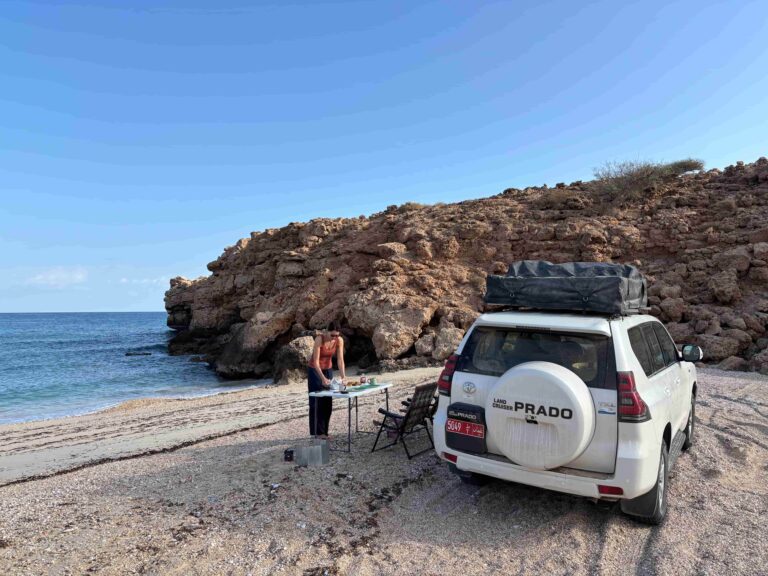
In Sur we walked through the souq and along the corniche and beach. It’s ok but there isn’t a whole lot going on. Sur is famous for dhow building – remember the Omanis were heading back and forth to Zanzibar in the 1800s when Stone Town was actually the capital of the Sultanate instead of Muscat, for a while. There’s a dhow factory you can check out – we didn’t.
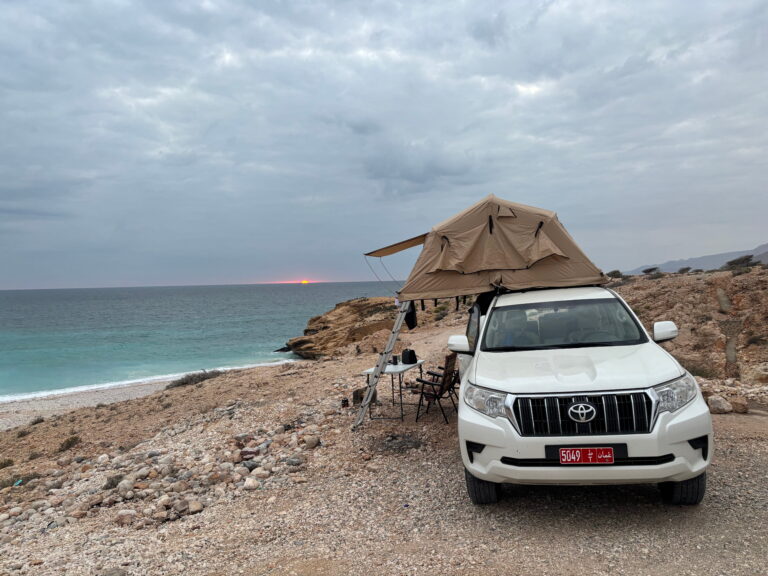
From Sur we headed to Wadi Tiwi and drove partway up the wadi. Some locals told us that the road gets very narrow the further up you go, especially if you meet oncoming traffic. We camped nearby Wadi Tiwi at Fin’s Beach and Cliff Camping .
DAY 11 – Tiwi Beach/Wadi Shams > Wadi Al Arbeieen
Kilometers: 60 | Driving time: 1 hr
Try to reach the entrance to the extremely popular Wadi Shams before 8:00 a.m. There’s a short boat ride from the carpark at the entrance to the start of the trail. The boat starts running at 7:00 a.m. We saw people wearing life jackets already in the carpark. Even better, we saw people doing the whole walk wearing life jackets, which is an interesting approach to hiking on dry land. The only thing you might need is water shoes, for the very end of the trail.
After the two minute boat ride you have a forty-five minute walk to a pool where you can swim, and stop there if you like. Or, swim onwards for about twenty minutes and climb on some slippery rocks to reach a narrow gap that leads into the cave at the end of the wadi.
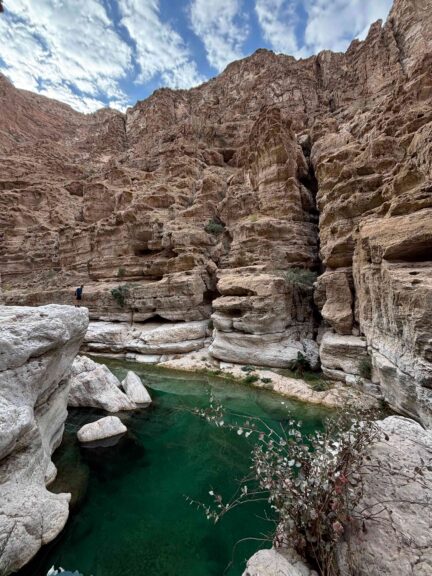
After Wadi Shams we got back in the car and drove on to Wadi Al Arbeieen. That one was very quiet and I’d choose it any day over Wadi Tiwi or Wadi Shams.
We parked at the end of the road into Wadi Al Arbeieen, and then hiked further up the wadi.
It’s a bit strenuous in spots with some scrambling around on large boulders but generally the path goes along the irrigation system on the left side of the wadi.
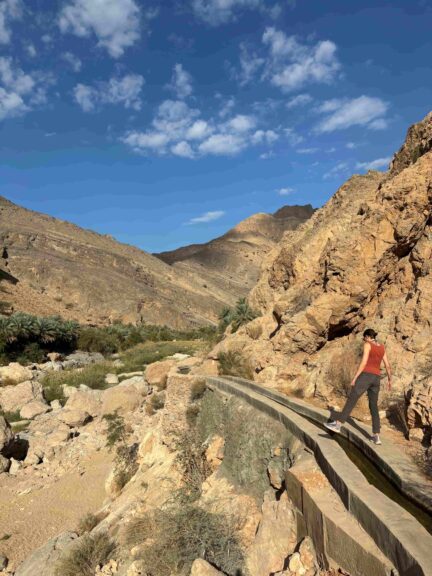
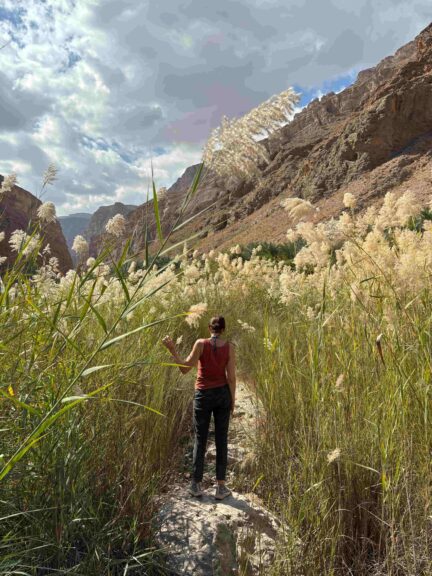
You can stop and swim in hidden, glass-clear pools and hear a pebble drop. Absolutely beautiful.
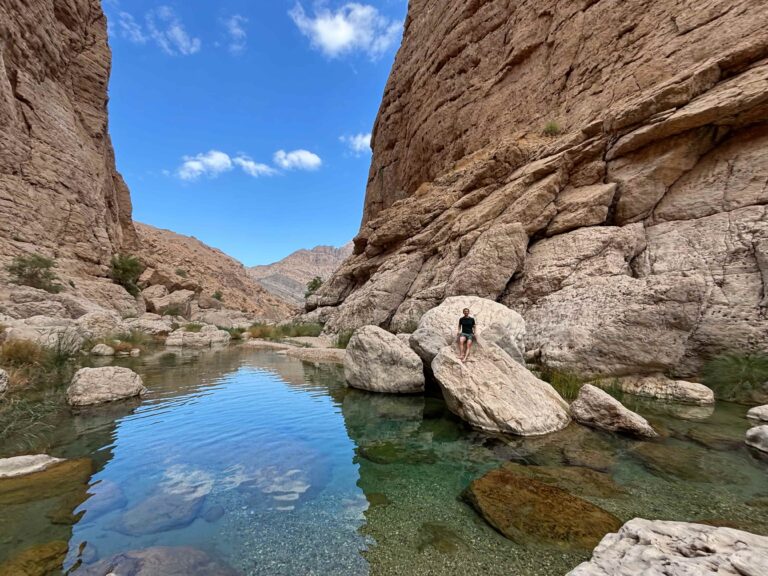
We hiked back to the car and then drove back down the wadi and found a spot to camp away from the road:
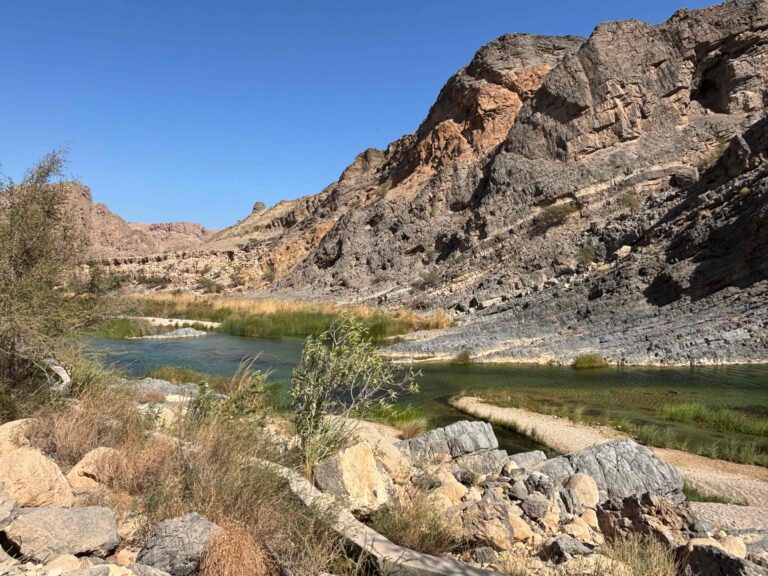
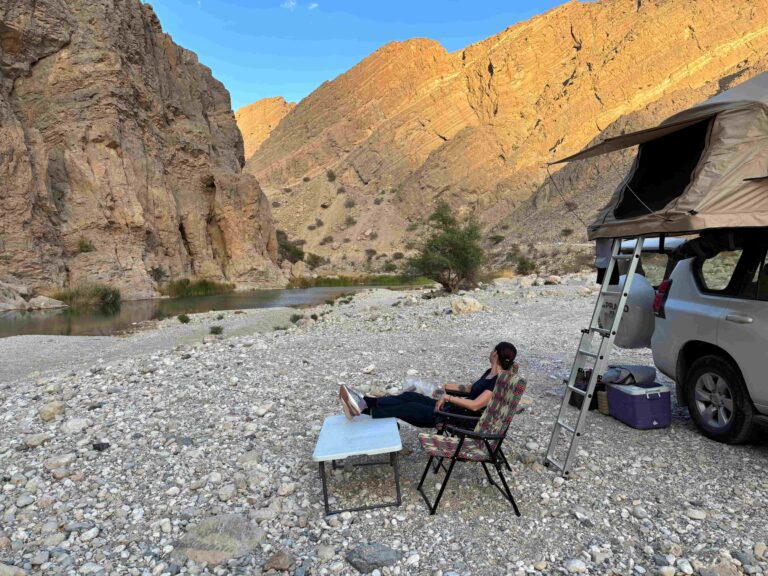
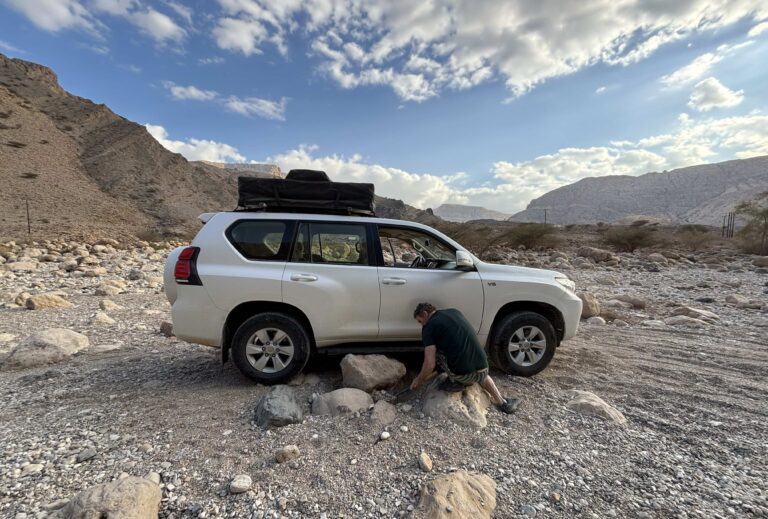
If you’re looking for the same site, just watch out for the large rocks — we actually got stuck on one, and did some creative engineering using other rocks as ramps and levers to get off it. Whatever. Team work makes the dream work.
DAY 12 – Wadi Al Arbeieen > Seeb (Daymaniyat Islands) > Muscat
Kilometers: 170 | Driving time: 2 hrs
After breakfast in our rocky campsite, we drove about two hours (170 km) to the port in Seeb.
About three days earlier we’d booked onto a half-day trip to the Daymaniyat Islands to snorkel with turtles. Many companies offer this, they are easy to find and book over WhatsApp. Once you get to the port you just park and then find the agreed upon gate to meet your captain. A lot of boats leave around the same time and they all seem to go to the exact same spots, so the water gets frantically busy. Still, swimming with the turtles was really cool and there were a lot of them. There were also a lot of ‘influencers’ documenting every_single_splash of the trip.
In season, you can apparently snorkel with whale sharks too – I can’t even imagine how the whale sharks would fit in these crowds. If you want amazing snorkelling with whale sharks, try Mafia island off Tanzania – or at least read my story about it.
The boat trip cost 25 OMR per person, including some very sad snacks and drinks, and the snorkeling equipment. It’s a fun drive on a fast boat and some time on a pretty beach too, so all-in-all not the worst day ever.
We arrived back at the port around sunset and camped just outside Muscat for the night.
Back to Muscat
We packed up camp one last time and drove back to Muscat. With the car handed off by 10.00 we went out breakfast and spent the rest of the day checking out the city.
Roadtripping in Oman, a summary: yes, we got stuck in the sand (twice). We got stuck right on a rock too, somehow. Got lost in the desert briefly. Dug a landcruiser out of the sand with my hands. We cooked ten or twelve dinners on a campstove: nothing tastes better, although morning coffee on a long white beach comes close. We spent almost two weeks in a rooftent, occasionally showering under a hosepipe dangling from the same. And all those nights next to a campfire, up with the sun in a cool and silent wadi. Long drives and short drives, immersed in beautiful nature that changed around us by the day or hour…
I wouldn’t have it any other way, and you should definitely take this roadtrip.
Read more
We didn’t get to Oman just like that – we came from Iraq. You can read about our guide to overland travel in Iraq by public transport, here. Or to read more stories and guides about travelling in the Middle East in general, you might want to take a look at any of these posts. Since you’re in the neighborhood, if you’re thinking about Saudi Arabia we’ve got you covered: Saudi Arabia travel guide and itinerary.
We’ve done other roadtrips like this one and with every one we do, we become a little bit more obsessed. Check out our other epic roadtrips in Asia and Africa, here.