We couldn’t spend all our time ogling the ceilings in Karbala’s magnificent mosques, so we took a daytrip from that holy city, to the site of ancient Babylon. But wait, there’s more – as I believe everyone reading this post knows, Saddam Hussein had a palace handily located overlooking the ruins. Getting into the palace is easier said than done: you can talk to the guards all you want but it’s closed to the public and there’s no official way in. Unofficially, we did hear of a guy climbing over the fence: but that’s highly not recommended.
It’s easy to get to Babylon by yourself on public transport. You could certainly sleep in nearby Hillah for the night, but either Karbala or Najaf is more interesting. I’d use one of those as a base and just daytrip to Babylon. We stayed in both Karbala and Najaf for a couple of nights each.
This post is about how to get to Babylon from Karbala, and explore Saddam Hussein’s palace while you’re at it (…if you’re lucky).
Ancient Babylon, a constant work in progress
Perhaps the ongoing cycle of destruction and restoration started around 600 BC, when King Nebuchadnezzar II drove the Egyptians out of Syria and then set his sights on Babylon. It had already been standing there next to the Euphrates for nearly 2000 years first in the form of a small village, then a brief and heady stint as an important capital, then dwindling into obscurity and sacked at least once.
The King’s idea was to make Babylon the most magnificent city in the world. It seems he succeeded, given that today we’ve all heard of his work – the Hanging Gardens, for example – even though there’s no trace of them left today.
Nebuchadnezzar died in 562 and Babylon’s good fortune ran out, falling to the Persian King Cyrus in 539, and eclipsed by Persepolis. Decline and destruction (and a spate of Zoroastrian fanaticism) left the city in bits and pieces by the time Alexander the Great turned up. He knew a good fixer-upper when he saw one, and started a new campaign of restoration. But then he died in Babylon in 323 BC. And the city changed hands again, and again, as Empires came and went for a few more centuries.
The Mongols descended on Mesopotamia in 1258 and the preservation – let alone restoration – of anything at all was not something they were known for. Hulagu Khan massacred the entire population of Baghdad and much of the surrounding countryside. There was barely time to recover from that before Timur swept in and unleashed another round of epic violence, in 1401.
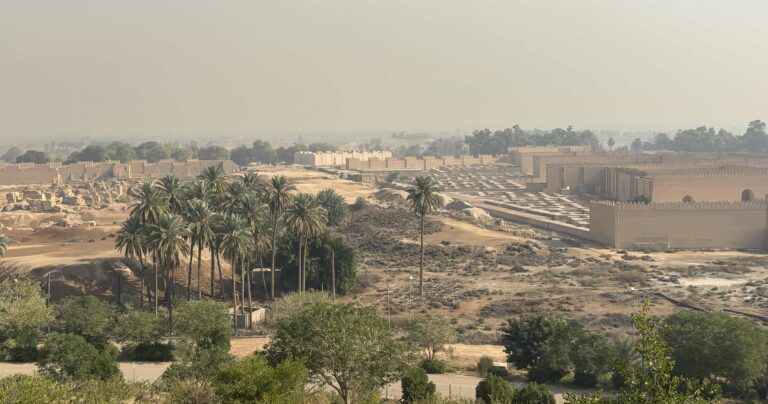
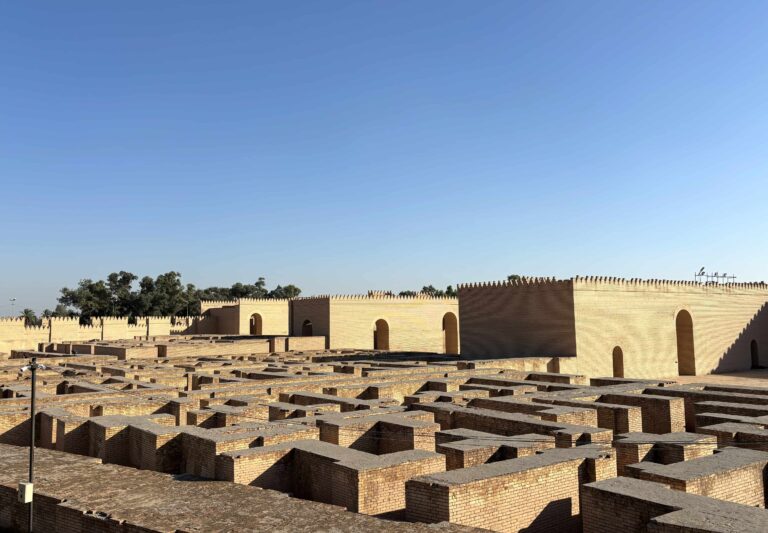
In more recent times, excavation started on the ancient city in the 1800s and the cycle slowly started again. Saddam Hussein embarked on an extensive project in the 1980s, especially intent on restoring Nebuchadnezzar’s huge palace to its original glory. In fact he ordered so much work that Babylon became the most-restored site in Iraq. And just as Nebuchadnezzar had bricks stamped with his name, so too did Saddam. Both can been seen today.
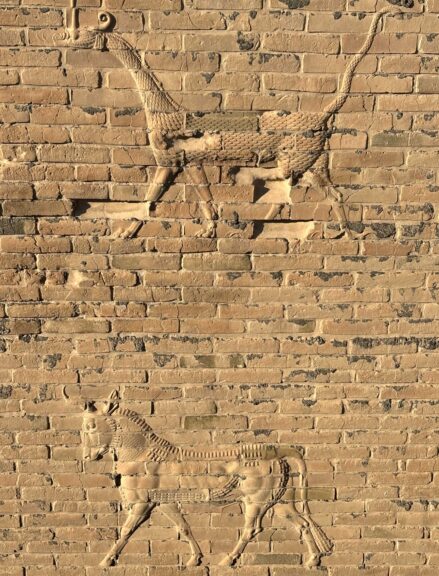
You can still see original reliefs of bulls and chimeras, here and there. The famous Ishtar gate is a copy: the real one was dismantled and taken in (thousands of) pieces to Germany by the team of archaeologists who did the excavations after WW1. They put it back together in a museum in Berlin – and it survived WW2.
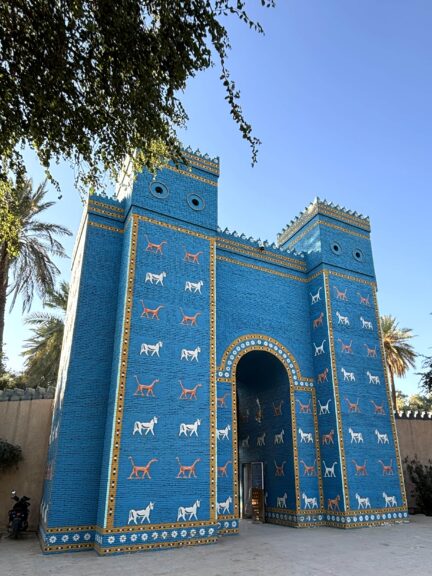
Babylon today, in our lowly opinion: not so interesting to look at. It’s so heavily restored as to feel practically new, while old parts are mostly rubble. You really need to use your imagination (and ideally bring a guidebook). Still, it IS Babylon and you should go.
Saddam Hussein’s palace at Babylon
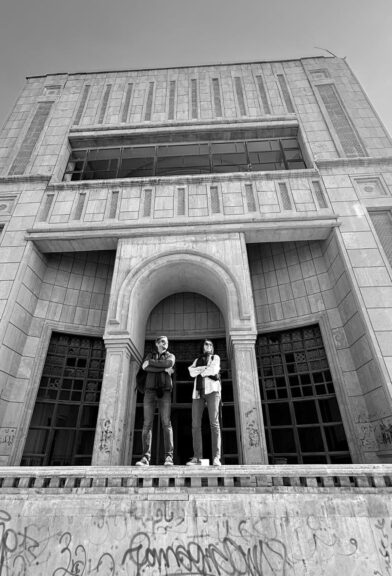
Not just content with restoring Babylon, while he was at it Saddam Hussein had a palace built to look at it from, like a modern-day Nebuchadnezzar. It’s not known if he ever spent much time here – he had many palaces throughout Iraq – but there’s no stopping a megalomaniac from dreaming.
During the war in 2003 American forces captured the palace and used it as a base for a while. Once they left the locals descended, ripping out whatever they could use for their own restorations after the war.
Exploring inside the palace
Empty and abandoned, the palace looms over the silent kingdom of the distant past, and I’ll bet that you want to get in there for a look around. We definitely wanted to, so we came with a local friend.
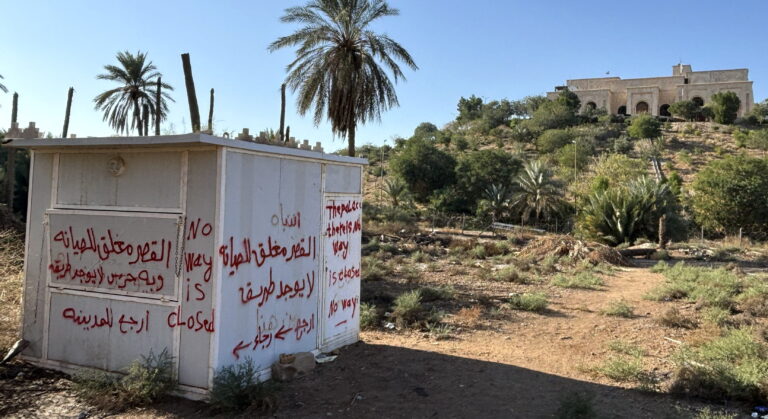
If you’re going to try, you should time it for the same day you visit Babylon. You need two things:
- the ticket to the Babylon site, since access to the palace is from inside the historical site’s checkpoints
- a guide or a local friend to sort it out for you. The palace is fenced off and guarded by the military. Apparently you can talk to the guards for hours if you want, but the palace is off-limits and they will not let you in by yourself.
However you arrange this: finding a guide, or if you’ve got a local friend showing you around – it’s still not a guarantee they’ll let you in. But if they do, you walk around past the left side of the Ishtar gate and into a family park which costs 1k dinar for locals (…and people with them). From there it’s a short stroll to the fenced entry to the palace grounds.
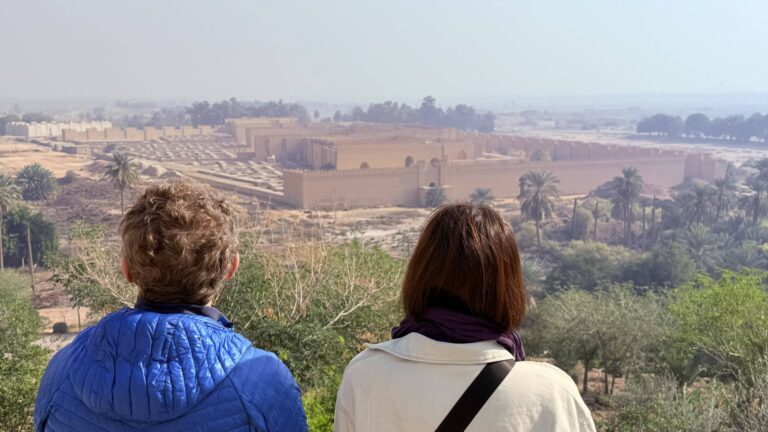
With our friend we went right up the hillside and into the monstrous, abandoned relic.
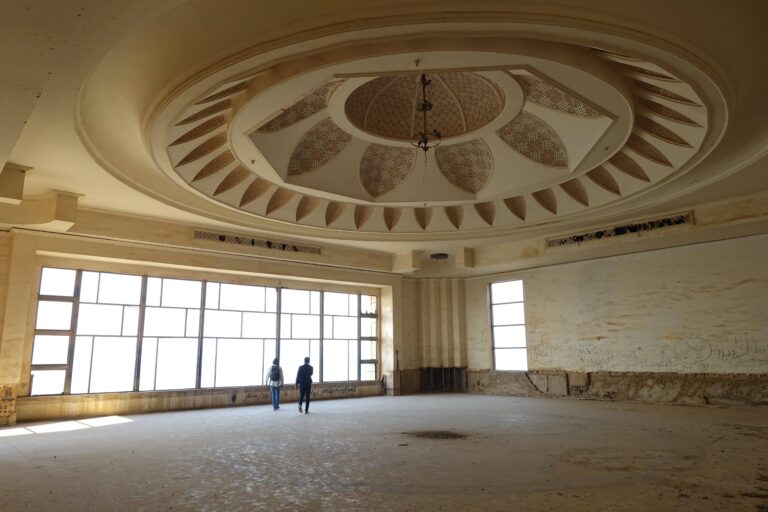
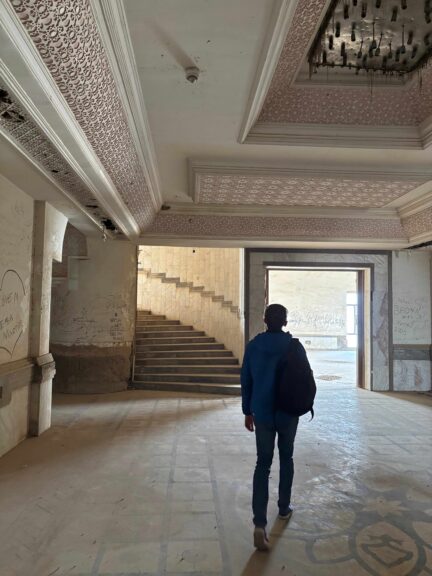
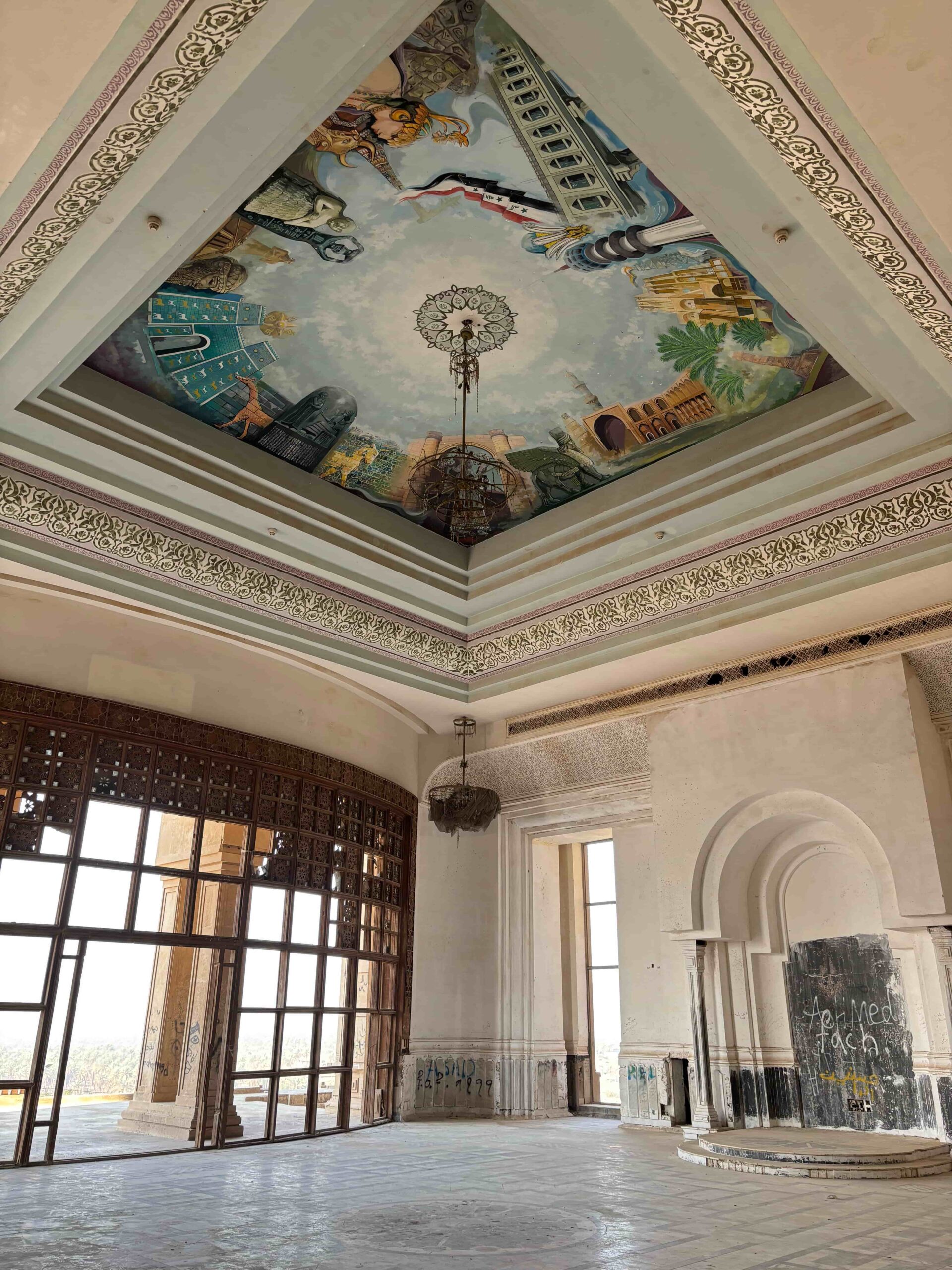
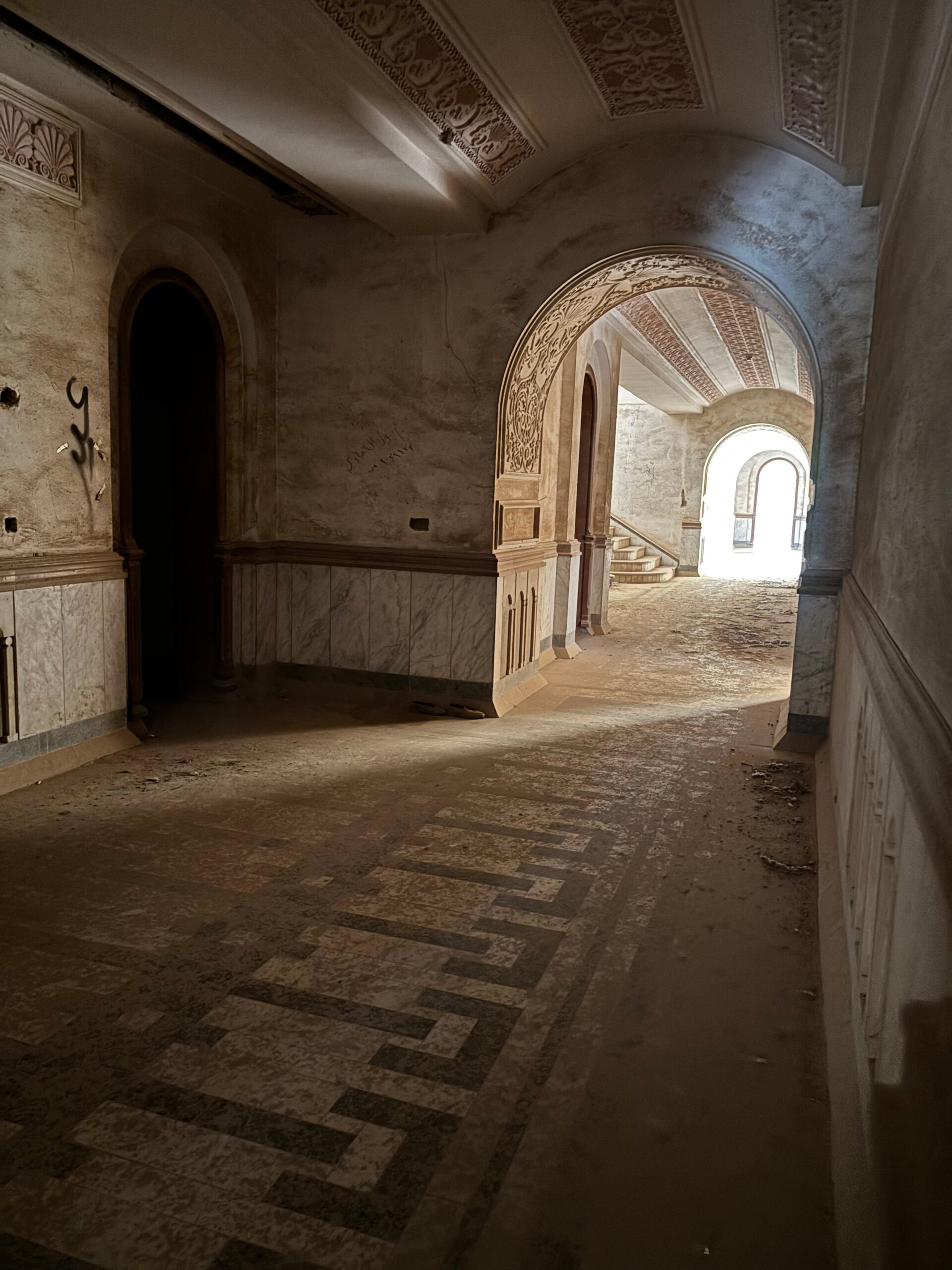
We prowled through the echoing rooms and climbed the exposed staircases to the very top of the palace for a whole different look at Babylon.
How to get to Babylon from Karbala
Your transit point is Hillah, the city Babylon is just a bit north of.
From our hotel in Karbala, we walked to Hillah (Babylon) Terminal in the new city. There it’s easy to get a minibus going to Hillah for about 2k dinar per person.
After waiting for it to fill with passengers, it takes about an hour to Hillah. You get dropped off near a busy intersection under the bridge, and there should be at least a few taxi drivers around. Ask one of them to take you to Babylon. It might not be a bad idea to have a photo of the gate ready on your phone – as our driver first took us up the hill to the huge Babylon sign overlooking the city and we didn’t really want to go there.
The taxi cost about 5k dinar to the actual site itself and takes less than fifteen minutes. Tickets to Babylon cost 25k dinar each.
Getting back to Karbala from Babylon
First, we grabbed a taxi from the carpark out front next to the Ishtar gate back to Hillah. Tell the driver you are getting a bus to Karbala (or Najaf, as the case may be) – that’s what we did and the driver dropped us right off at the same busy intersection we arrived at. He even pointed out the next minibus we could go for.
If there isn’t a bus already waiting there, just watch and flag the next one heading back to Karbala.
Have a look at this post about Karbala and Najaf, for more information about the ins and outs of visiting these two holy cities.
Read more
If you’re planning a trip to Iraq, have a look at our Iraq travel guide and itinerary. And, find out more about our own independent travels in Iraq, here.
Check out the Destinations page for travel guides and stories about our off-beat adventures all over the Middle East and beyond.